Michael Crummey’s Newfoundland

Anyone who’s been to ‘The Rock’ knows Newfoundlanders love to tell stories. I can’t think of any Newfoundland and Labrador author more accomplished than Michael Crummey.

Over a span of six novels, from River Thieves (2001) to The Adversary (2023), Crummey has wrangled and harnessed Newfoundland English, transforming an ever-changing spoken vernacular into prose – a difficult task, one he’s discharged with flying colours.

Each of Crummey’s novels is both a haunting tale and a feast of words. He spins splendid descriptions and memorable dialogs. If you want to hear Newfoundland and feel it too, pick up a Crummey novel.

Crummey’s latest, The Adversary, winner of the 2025 International Dublin Literary Award, catapults the reader to the fishing port of Mockbeggar, Newfoundland. It’s the late 1700s. One year the Atlantic is choked with cod; the next, it’s barren. One day the sky is clear; the next, it’s a howling grey wolf. The novel delivers an evocative tale, an unsparing story of two warring siblings.

PS: List of Michael Crummey novels in order of publication: River Thieves (2001); The Wreckage (2005); Galore (2009); Sweetland (2014); The Innocents (2019); The Adversary (2023). Crummey has also published poetry, short stories, and non-fiction. For further information, see the author on Wikipedia: https://en.wikipedia.org/wiki/Michael_Crummey.
Silver Moon Rising: Fact vs. Fiction

From autocrats to plutocrats to the guy next door, everyone is lying. ‘What about novelists, AMP?’ Absolutely, without a doubt. But they’re not lying to hoodwink us. Rather, they’re lying to create fiction, to entertain us.

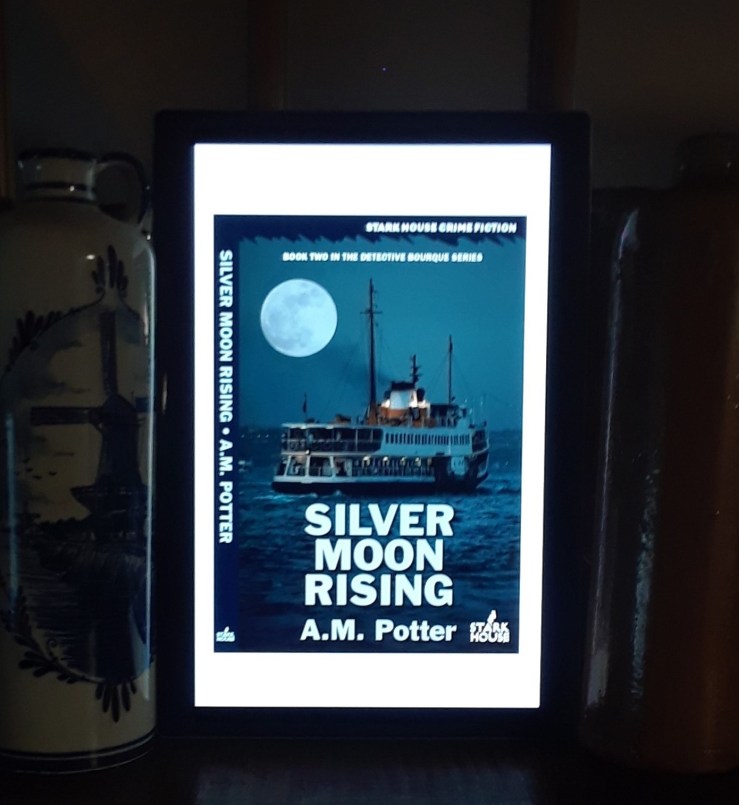
An earlier North Noir post noted that every work of fiction sits on a fact-fiction continuum. On one end of the continuum there is pure fact; on the other, pure invention. Much of any novel sits somewhere in between. Take Silver Moon Rising (Detective Bourque Book Two). What facts bleed into its fiction? The main murderee, Daniel John Fitzgerald (Dan-Dan), is loosely based on John Fitzgerald Kennedy Jr. (John-John), who died tragically in a 1999 plane crash. Dan-Dan Fitzgerald’s best friend, Chase Heaney, is loosely based on Paul Watson of Greenpeace. However, the resemblances are, as they say, incidental. Fitzgerald and Heaney are characters in a whodunit – aka, an entertainment with teeth.

Silver Moon Rising probes political activism and loss, not only the loss of human lives, but the impending loss of an entire species — the right whale. New Englanders have been coming to terms with whale mortality for centuries, as evinced by Herman Melville’s Moby Dick (1851). In Melville’s tale, when humans and whales collide, things unravel. As they do in Silver Moon Rising.

For sales information, click here.

To preview the novel, download a free teaser: Download

A Little Entertainment (Just for the Heck of It)

A friend of mine used to call certain men “entertaining.” They might not be marriage material, but they could be fun for a dalliance. They were certainly a diversion; they made her laugh. As for serious objects of desire, they had to have at least some entertainment value. What good was a partner – be they rich, handsome, or blameless – without a sense of humour?

Okay, AMP,’ you say, ‘this isn’t a matching-making blog.’ Right. Onward, from amour to fiction, just for the heck of it. Critics and scholars often classify novels as being either commercial (i.e., entertaining) or literary. Nobel-prize nominee Graham Greene, widely-read and widely-respected, called some of his novels “entertainments.” Critics said it downgraded his oeuvre. I don’t see it that way. In my view, to be entertaining is a plus, not a liability. Books won’t save the world. However, they might take your mind off a few woes or tickle your brain – a little entertainment.

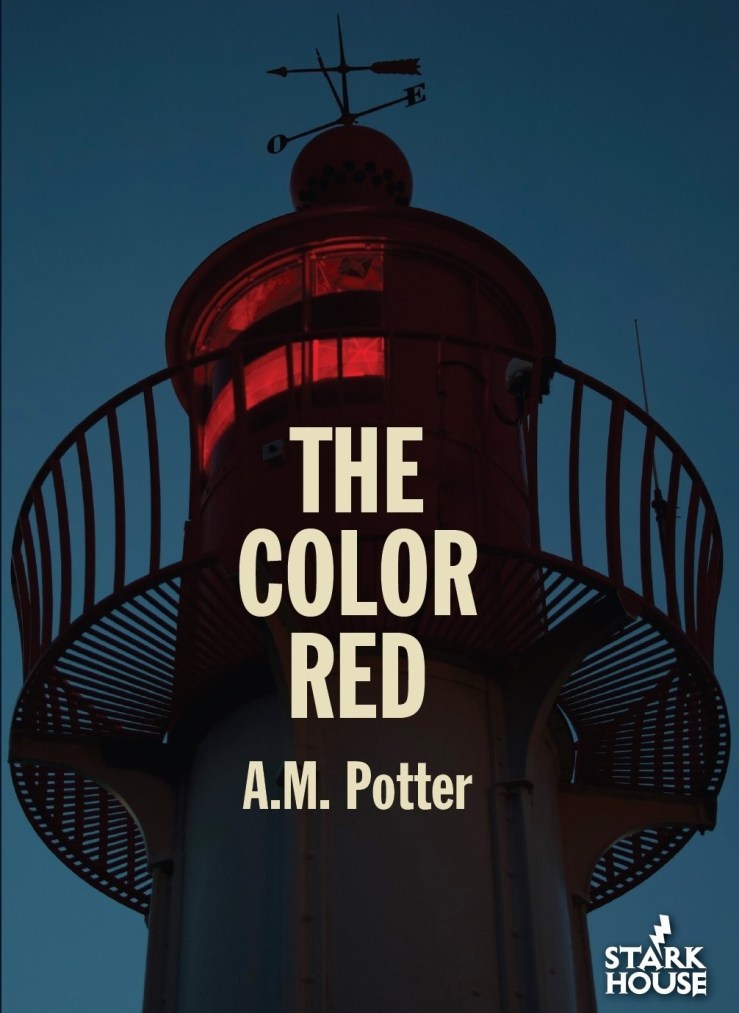
The Color Red: Bleeding Facts into Fiction

The history of the novel has been characterized by unending experimentation. However, one thing has remained constant. Novels are based on facts, real-world details that are twisted and turned to spin a story.

Every work of fiction sits on a fact-fiction continuum. On one end of the continuum there is pure fact; on the other, pure invention. Much of any novel sits somewhere in between.

What about The Color Red? What facts bleed into its fiction? The novel’s main murderee, Rollo Novak, loosely resembles Robert Herjavec; Novak’s business associate, Karlos Vega, loosely resembles Kevin O’Leary. Readers might recognize the names: Herjavec and O’Leary appeared on Dragon’s Den in Canada and now appear on Shark Tank in the US. However, the resemblance isn’t crucial to the story. Novak’s first wife, Melanya, was born in Slovenia. She might remind readers of a First Lady named Melania, who was also born in Slovenia. Of course, while Melanya Novak may mirror someone – anyone – she’s just a character in a novel. As copyright disclaimers say, “Any resemblance to actual persons is entirely coincidental.”

Then there’s Detective Lt. Ivy Bourque, the main character in the novel as well as the series. She’s not based on anyone “factual”; however, she is a prototypical New Englander: amiable, capable, and perceptive. On her father’s side, her French-Canadian heritage pays homage to Jack Kerouac, whose parents migrated from Quebec to Massachusetts in the early 1900s.

One final note for aficionados of fact-in-fiction and true crime stories. The main crime scene in The Color Red, an indoor pool, echoes the crime scene of a recent double murder in Toronto, Canada: the Barry and Honey Sherman murders. Echoes, I say. Okay, I’ve said enough. 😉 If I keep going, I’ll leak some spoilers.

Click here for sales information on THE COLOR RED.

To preview THE COLOR RED, download the free teaser below.

Inside Story: A Martin Amis Funhouse

Review of Inside Story by Martin Amis, 2020.

An Amis novel is like the weather in May. You never know what to expect. I’ve loved two of his novels (London Fields and Time’s Arrow), liked others, and, on occasion, been completely disappointed.

Amis’s prose is inventive, but it’s often overdone. He’s certainly no Hemingway, limiting adverbs and adjectives. On the contrary, Amis wields them like a boxer, at times jabbing, but usually lining them up for a haymaker. Over the course of five decades, he’s managed to alienate both sides of the reading divide: to literary stuffed shirts, he’s uncouth; to genre buffs, he’s too high-minded. As for Inside Story, I didn’t love it, yet it tickled my funny bone. And my mind. I laughed aloud and, every twenty or so pages, I stopped to think – on everything from Donald Trump to death to beauty to the history of the novel.

Inside Story is a mashup of fictionalized autobiography, literary observations, and sociopolitical opinions. Although subtitled A Novel, the book is largely (and unabashedly) biographical. When Amis is at his best, the narrative has a gravitational pull. His words spin a funhouse of warped mirrors. He regales readers with unique insights, both frivolous and cerebral. Some dismiss Amis as sexist. Others say he’s a bounder; still others, a little shite. I don’t care. I’m loathe to shun books due to their writer’s transgressions. [Having said that, if Putin writes a book, I’ll shred it.]

Alright, back to Inside Story. Martin Amis grew up in a time and place of, let’s say, amorous exuberance (Swinging London, 1960s-70s). If you enter his funhouse, you’ll encounter womanizing, yes, and braggadocio, but also poignancy, self-doubt, and generosity of spirit.

A few excerpts from Inside Story:

On the English language: “Great Britain no longer had an empire – except the empire of words; not the imperial state, just the imperial tongue.”

On the pretzel logic of Biblical hellfire: “It’s not that eternity never ends – it never even begins.”

Describing Donald Trump: “That chicken-hawk, that valorised ignoramus, that titanic vulgarian, dishonest to the ends of his hair.”