Windows into Other Worlds

To give a book is to give a window into another world. Even if I like a particular author, I rarely give one of their books blindly, without first reading it.

Books are entirely subjective. You never know if a book will satisfy someone or, better yet, thrill them. Regardless, here are some titles I recommend (most are recent):

NON-FICTION

Figures In A Landscape by Paul Theroux, 2018. Essays for all seasons, from travel pieces to literary criticism to profiles of Elizabeth Taylor, Oliver Sacks, and Robin Williams. Full disclosure: One, I skimmed a few non-travel essays that didn’t grab me. Two, I’m not a fan of any of Theroux’s fiction.

The Rub of Time by Martin Amis, 2018. Essays and Reportage, 1994-2017. A smorgasbord of Amis treats, mostly literary or political, with topics ranging from Saul Bellow to Donald Trump. Amis is regarded by some as the Bad Boy of Brit Lit. They say he’s crass. I say he’s entertaining. Full disclosure: One, I skimmed a few of the almost 50 essays; they weren’t in my wheelhouse. Two, I find Amis’s latest fiction unrewarding.

{As an aside, I feel no compunction to read everything that comes my way – even if it is supposed to be “good for me” or part of the canon.}

FICTION

The Testaments by Margaret Atwood, 2019. 2019 Booker Prize Co-winner. Sequel to The Handmaid’s Tale. Clear-eyed, sardonic, accessible. Atwood doesn’t aestheticize The Testaments. The narrative is straightforward. As with all good novels, the prose is subservient to the plot.

Last but not least, my crime pick:
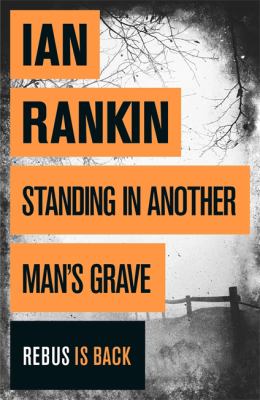
Standing In Another Man’s Grave by Ian Rankin, 2012. One of my favourites from the King of Scottish Noir. Rankin delivers brilliant banter and black humour wrapped in a cracking whodunit.

Crime Time: A Two-headed Compulsion

Why do writers write crime novels? Why do readers read them? We’d have to delve into the DSM (Diagnostic and Statistical Manual of Mental Disorders). 😉 We’d need a thousand hours – no, a million.

Let’s look at things from the reader’s side of the page. That’s what really matters: why readers read, not why writers write. It’s a large question. However, I’m going to take a succinct approach. Crime fiction suffuses the zeitgeist. Crime readers have favourite styles: cozy mystery, private investigator, police procedural, etc. Regardless, they’re all fascinated with one thing. Murder. Why?

I see it as a two-headed compulsion. One, readers want to experience the other side of life: death. Two, they want to experience fear. They crave it, but only fictionally: fear of the unknown, fear of the invader, fear of reprisal, fear of something that will disrupt their life – or end it. Fictionally, of course.

PS: Book sellers claim that everything hinges on sales, i.e., on book buyers. I beg to differ. Buyers are great, but everything hinges on readers. Period. That includes those who borrow from libraries or share a book a dozen times. The more shares (the more readers), the merrier.

North Noir Defined

What is North Noir?” In short, it’s detective fiction set in Northern USA and Canada.

The North element refers to the location of two detective series, one set in New England and the other in Ontario. The police work is close to the ground. There are no extended car chases, helicopter missions, or gun battles – no over-the-top clichés.

The Noir element refers to a tradition of crime writing linked to film noir, to movies such as The Maltese Falcon, which was first a novel. Noir fiction doesn’t dwell on characters’ feelings. Similarly, the female protagonists in North Noir are not sentimental, although they are empathetic and intuitive.

The crime/mystery genre turns on whodunit puzzles. Readers expect to be both challenged and entertained. The North Noir novels deliver more than puzzles and blood and guts. I always embed – very deeply (no preaching) – an existential conundrum in my novels. The majority of murders hinge on money. In a word, greed. In The Color Red, the main murderee is killed because of his renunciation of money, his anti-greed. Readers will get a baffling puzzle; they’ll also find a deeply buried ethical message. For me, all novels – even whodunits – should have an existential core.

PS: The first three North Noir novels – Bay of Blood, The Color Red (Bourque Book One), and Silver Moon Rising (Bourque Book Two) – are available in stores and online; click here for full details.

Lexicography: What Can You Write with 50 Words? … Web 3.0

For many years, I worked in IT and wrote web-based software – mostly middleware – using various programming languages, among them Java and .NET. “OK, AMP, but what’s that got to do with writing fiction?” Patience, Grasshopper.

Most computer languages have no more than 100 keywords or ‘reserved’ words, and fifty or so main ones, such as if, then, for, etc. I used those fifty words over and over again. In essence, the world was reduced to fifty words.

How would that work with human language? Fifty words in English? Not a good thing. Are fifty computer keywords really enough? You’d think the paucity of computer lexicons would render the IT world flat and colourless. It could, and it did – from the 1950s to the 1980s. Think mainframes and keypunch cards.

Then came the UX (User eXperience) Revolution: user-friendly interfaces and web browsers. Next came smartphones and apps. Consider what’s been created with a fifty-word base: Web 1.0 and Web 2.0. Of course, you could say that IT has pauperized the world, reduced it to two-dimensional screens, to a virtual realm, to a hell of trolls. Yep, there IS all that. But there is more. For instance, there’s blog space. You and I are ‘talking’ now. Well, I imagine you talking with me. That’s how I think of it.

Let’s do a very cursory comparison of a human language and a computer language. When learning a new human language, say English, if you master 1000 words you’re well on your way – not to being a poet, but to being functionally literate. Conversely, Shakespeare used over 21,000 words (and is credited with coining 1,800 of them). The Oxford English Dictionary contains about 200,000 entries. When learning to program in C++, you learn fifty or so keywords. Only fifty! It’s amazing what a CPU can do with fifty keywords.

Think of human culture as a whole. Human languages have spawned millions of books. Computer languages have spawned millions of URLs. I’m not suggesting we can compare human lexicons to computer lexicons. It’d be like comparing a book to a byte. So, let’s move on. At the moment, Web 3.0 is in its infancy. It will use the same fifty keywords. Can you expect them to accurately mirror the real world? No. But coders will keep trying.

PS: To all the code warriors and IT professionals out there: You’re right, you use thousands of variables and elements, not fifty. But I’m referring to reserved words. Look what you’ve done with them. Billions of humans are glued to their phones. Which brings new meaning to the old maxim: “Words are powerful.”

Playing the E-Promotion Game

There’s a fine line between promotion and flaming, between enticing people to look at something and harassing them. The e-promotion world is huge. Here’s a look at one small country: the author/publishing nation. Caveat: This post may only appeal to authors. However, if you’re interested in e-promotion – be it for books, services, or anything else – read on.

The Game. “You’re an author now,” my publisher said. “Enlarge your social media footprint.”

Size twelve wasn’t good enough. Size twenty-four was the ticket. So, I wrote blog posts. I sent broadcast emails. I facebooked, linkedin, tweeted, and instagrammed. I was a hamster on the promo wheel. But who was caught on a bigger wheel? The people who knew me. For example, those who’d been online friends for years. Suddenly I was posting a river. Sorry about that. And thank you for navigating the river.

Let’s leave aside tweets and I-grams and focus on blogging. When you publish blog posts, you are given the option of connecting to readers via the main social media dragons of the day (such as fb and LinkedIn). The dragons ask to use your email contacts to generate more traffic.

Sounds good, so you let them. They then ingest all the email addresses you’ve ever sent email to or received email from. The dragons blast every contact, even people who don’t remember you or emailed you ten years ago. Your contacts get burned. But maybe some of them like what your site delivers. If enough of them are happy, there’s a win-win.

I’m no social media guru. However, I have a few simple tips about blogging. ONE: When the dragons ask to use your email contacts, uncheck ‘All’ and manually select the contacts you want. TWO: Pick the right time to publish your posts. I usually chose the weekend (I don’t want to blast people during the work week). THREE: Keep your posts short; most of mine are under 300 words (be good to your time-pressed readers).