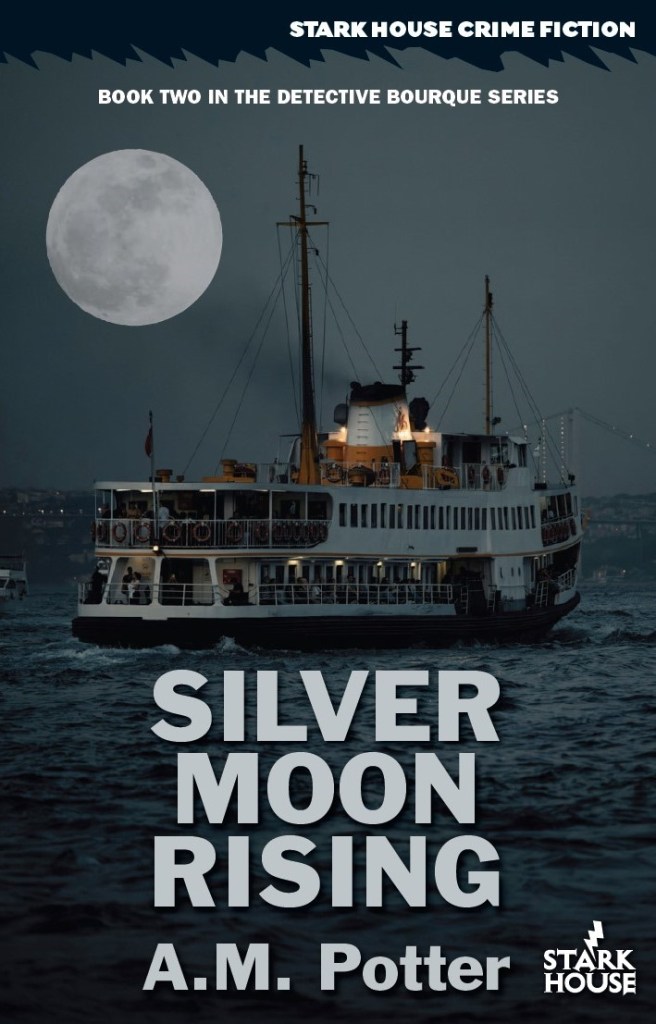
Kudos from Publishers Weekly for Silver Moon Rising

Silver Moon Rising (Detective Bourque #2) by A.M. Potter. Stark House. ISBN 979-8-88601-100-5

Publishers Weekly Review: Potter’s atmospheric second procedural featuring Lt. Ivy Bourque of the Cape & Islands Detective Unit is even better than its predecessor (The Color Red). At the outset, Bourque is called to a Martha’s Vineyard ferry to help locate Daniel Fitzgerald, the handsome young scion of a powerful New England dynasty, who vanished during a nighttime ferry crossing. After investigators find Daniel’s body, knifed in the heart, Ivy learns that he had recently severed ties with his family and devoted himself to various social causes, including cleaning up the Appalachian Trail, fighting climate change, and protecting whales. His protest methods occasionally got him in trouble with the law and courted controversy. When more people — some linked to Daniel — are stabbed to death, Ivy must figure out which of Daniel’s enemies, including Massachusetts politicians and corporate whaling interests, are angry enough to kill. Potter spends worthwhile time illustrating how Ivy’s background in organic chemistry benefits her investigative work, and evokes his brackish, blood-soaked setting with aplomb. This series continues to impress. – Publishers Weekly, Sept 2024

To purchase Silver Moon Rising, click here for information.
Silver Moon Rising: Fact vs. Fiction

From autocrats to plutocrats to the guy next door, everyone is lying. ‘What about novelists, AMP?’ Absolutely, without a doubt. But they’re not lying to hoodwink us. Rather, they’re lying to create fiction, to entertain us.

An earlier North Noir post noted that every work of fiction sits on a fact-fiction continuum. On one end of the continuum there is pure fact; on the other, pure invention. Much of any novel sits somewhere in between. Take Silver Moon Rising (Detective Bourque Book Two). What facts bleed into its fiction? The main murderee, Daniel John Fitzgerald (Dan-Dan), is loosely based on John Fitzgerald Kennedy Jr. (John-John), who died tragically in a 1999 plane crash. Dan-Dan Fitzgerald’s best friend, Chase Heaney, is loosely based on Paul Watson of Greenpeace. However, the resemblances are, as they say, incidental. Fitzgerald and Heaney are characters in a whodunit – aka, an entertainment with teeth.

Silver Moon Rising probes political activism and loss, not only the loss of human lives, but the impending loss of an entire species — the right whale. New Englanders have been coming to terms with whale mortality for centuries, as evinced by Herman Melville’s Moby Dick (1851). In Melville’s tale, when humans and whales collide, things unravel. As they do in Silver Moon Rising.

For sales information, click here.

To preview the novel, download a free teaser: Download

Silver Moon Rising: Release Day, September 4, 2024

Silver Moon Rising is now available. Click here for sales information.

Silver Moon Rising, Potter’s sequel to The Color Red (2023), portrays Bourque as an increasingly confident, intuitive detective, giving plenty of room for this burgeoning series to grow.” – Booklist, the best book reviews for libraries, the best books for book clubs, published by the American Library Association

Lieutenant Ivy Bourque of the Cape & Islands Detective Unit is called to a Martha’s Vineyard ferry at midnight. The estranged son of Massachusetts’ most famous political family is dead. A tangled web leads to Cuttyhunk Island off Cape Cod.

To preview SILVER MOON RISING, download the free teaser below.

Advance Kudos for Silver Moon Rising

Kudos are coming in for Silver Moon Rising, Book Two in the Detective Bourque series.

Release Date: September 4, 2024 | Publisher: Stark House Press, USA

Lieutenant Ivy Bourque of the Cape & Islands Detective Unit is called to a Martha’s Vineyard ferry at midnight. The estranged son of Massachusetts’ most famous political family is dead. A tangled web leads to Cuttyhunk Island off Cape Cod.

What critics and advance readers are saying:

Silver Moon Rising, Potter’s sequel to The Color Red (2023), portrays Bourque as an increasingly confident, intuitive detective … giving plenty of room for this burgeoning series to grow.” – Booklist, the best book reviews for libraries, the best books for book clubs, published by the American Library Association

“A.M. Potter continues to redefine murder mysteries. Silver Moon Rising pulls readers deeper into Cape Cod with pepper-paced dialogue and richly relatable characters. The new Bourque novel is another engaging read I couldn’t put down.” – Bill Arnott, author of the Gone Viking travelogues and A Perfect Day for a Walk

Silver Moon Rising is beautifully-written, a whodunit infused with intrigue, hubris, and loss. Put the Detective Bourque series on your watchlist.” – Mystery Maven Reviews

“If you haven’t read the first novel in the Detective Bourque series (The Color Red), you’ll want to after reading the second (Silver Moon Rising). Silver Moon Rising is well-plotted, set in inviting East Coast outports and hideaways, and with truly exceptional writing chops that leave a great many other formulaic bestsellers in the dust. Or the salty wake, more appropriately.” – Caroline Woodward, Author of Light Years: Memoir of a Modern Lighthouse Keeper

“Detective Ivy Bourque shines again. Silver Moon Rising is a compelling and thought-provoking sequel to The Color Red. Don’t miss this series.” – P.W. Tilley, former RCMP Detective

Silver Moon Rising’s gripping narrative carries you compulsively forward as it delivers intriguing details of detective procedures and Cape Cod history. Potter’s rich descriptions make me want to go there.” – Jane Bwye, author of Breath of Africa

Silver Moon Rising is a smart, action-packed police procedural whodunit that ranks among the best in this genre. The story grabs you at the outset, immersing you in the life and trials of Det. Bourque as she methodically tracks down the killer. This is a great read!” – David Hoath, PhD, X-Cop & Police Psychologist (Ret.)

2042 or Orwell, Didion, and The Writing Why

In Joan Didion’s last published work, Let Me Tell You What I Mean, she describes a talk she gave on writing, saying she stole the title of her talk from George Orwell’s essay Why I Write (1946). [Not into the writing game? You may want to skip ahead to the last paragraph.]

In Orwell’s essay, he argued that a writer writes from a desire to seem clever and be talked about. In addition to egoism, Orwell put pen to paper for political purposes. Hence we have, among other classics, Nineteen Eighty-Four.

Back to Didion. She relates that one reason she stole the title from Orwell was that she liked its cadence: “Three short unambiguous words that share a sound and the sound they share is this: I, I, I.”

“In many ways,” Didion claims, “writing is the act of saying I, of imposing oneself upon other people, of saying listen to me, see it my way, change your mind. It’s an aggressive, even a hostile act.”

Which brings me to today’s novelists. Why do they write? Orwell published his most famous novel (Nineteen Eighty-Four) in 1949; Didion, her final novel (The Last Thing He Wanted) in 1996. In 2024, few fiction authors write to impose anything on anybody, or admit to it. They don’t try to politicize readers. In my case, I aim to entertain them, which is not to say that I avoid topics like politics, ethics, or egoism.

Hmm, politics and egoism? Brings to mind a certain ex-president/wannabe dictator. ‘Hey, AMP,’ you say, ‘it could be fun to fictionalize him.’ True. How about an updated version of Orwell’s Big Brother, a double-speaking oaf with the attention span of a gnat? We’ll call it 2042.