During the course of 2021, I discovered a fine Irish-American novelist: Tana French, who writes literary detective novels set in or near Dublin (the Dublin Murder Squad series).
French’s dialog delivers the magic elixir of story-telling: presence. She can capture the essence of a character with a line or two of craic (conversation). She has the gift of the gab; like Elmore Leonard, her dialog will hook you.
French’s latest book, The Searcher (2020), is a stand-alone novel featuring retired cop Cal Hooper, a sympatico Yank who has washed up in the west of Ireland, looking to leave the mean streets of Chicago behind. Hooper worked Missing Persons in Chicago. As luck would have it, he becomes embroiled in a local misper case.
The story unfolds in rural Ireland, sans a slew of high-octane car chases or bloody gun battles. However, there’s no lack of drama. If you like stories told with a slow burn, yet plenty of flareups along the way, The Searcher is for you. If you want a policier with forensics and hardened criminals, look for French’s Dublin novels.
Recent consumer studies show that book purchases increased during the pandemic and that the Crime/Mystery genre registered the most purchases, more even than Romance.
Now that Covid-19 is a small scourge — in my locale, that is — I’m reading more mystery/detective novels, more tales of death. Although whodunits revolve around murder, the plots explore everything under the sun. They portray all aspects of humanity, from the positive to the negative. They are good and evil incarnate.
So, I’m back at it, checking out the “deadly” genre. I wonder how it will reflect the new zeitgeist. What’s going on out there? Uncertainty and innovation, to name a few things. And murder, of course. It would take more than a pandemic to rid the planet of murder, not to mention murder mysteries and romances. Read on, dear reader, whatever your favourite genres.
Who’s the reigning King of Southern Noir? James Lee Burke. Some say he’s the best living novelist in the United States. I wouldn’t go that far. However, he is one of the best living crime/detective novelists. He’s also a Philosopher King, a crime writer who salts his work with references to thinkers as diverse as Saint Paul and Jonathan Swift.
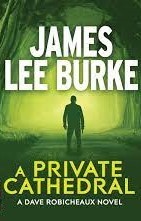
A Private Cathedral, 2020: The latest novel in Burke’s Dave Robicheaux series, set in New Iberia, Louisiana.
Burke wrote A Private Cathedral in his eighties. It mines the moral ground of his earlier Louisiana novels, deploying variations of previous protagonists and antagonists: tough but good-hearted cops, cultured but evil killers. Hence, some of the novel covers repeat territory (be aware, it’s bloody terrain).
As always with Burke, there are beautiful descriptive passages. The narrative shifts as the novel progresses, swerving from a detective tale to a morality tale, from forensics to fantasia — with every detail expertly rendered, all gifts from Burke’s fertile mind. As well-described and inventive as the gifts are, some hijack the storyline. At times, the tale felt like a cross between Milton’s Paradise Lost and a Stephen King horror story. I still enjoyed most of it. Nobody writes detective novels like James Lee Burke. He delivers gentility and degeneracy in equal measure.
PS: If you want to check out JLB’s earlier work, try Creole Belle or TheNew Iberia Blues.
“The light was strained, as though it were draining from the western sky into the earth, not to be seen again, robbing us of not only the day but the morrow as well. Of course, these feelings and perceptions are not uncommon in people my age. This was different. As I mentioned earlier, I have long believed that my generation is a transitional one and will be the last to remember what we refer to as a traditional America.”
“This was the era that I always believed was the best in our history. But it was gone, and to mourn its passing was to demean it. The ethereal moment lives on in the heart, so what is there to fear?”
“There are epiphanies most of us do not share with others. Among them is the hour when you make peace with death. You don’t plan the moment; you do not acquire it by study. Most likely you stumble upon it. It’s a revelatory moment, a recognition that death is simply another player in our midst, a fellow actor on Shakespeare’s grand stage, perhaps even one even more vulnerable than we are.”
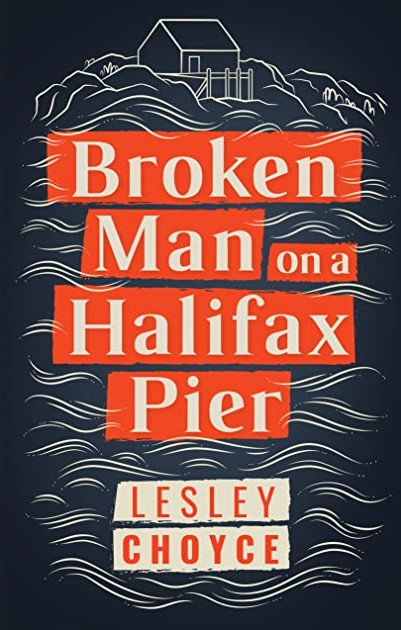
Broken Man on a Halifax Pier by Lesley Choyce, 2019. Dundurn.
Book reviews are supposed to be objective and largely impersonal. Caveat: This one is personal. Tune out if you wish.
Broken Man on a Halifax Pier swirls around Stewart Harbour, Nova Scotia, a fictionalized fishing post close to the real Sheet Harbour on the Eastern Shore, where I grew up. Although I left the shore at 17, I still feel it in my bones.
Some followers of this blog have been asking me to broaden my introduction. At the risk of boring others, here we go. [You can skip ahead to the review. See the last paragraph.] Shortly after leaving the shore, I headed to OZ, taking in the whole Red Continent, after which I kept goin’ down the road. Over a 20-year span, I “paused” to work many times – in Australia again and again, central and western Canada, the USA, England, and New Zealand – to fill my pockets and keep travelling, which I managed to do, seeing every continent except Antarctica. I only stopped because my pack was worn out. Just kidding.
But enough of my wanderlust. Back to the Halifax pier.
It could be that I’m prewired to like this book. Broken man on a Halifax pier happens to be a lyric from one of my favourite Stan Rogers songs: ‘Barrett’s Privateers.’
Now, the book review. To me, Broken Man on a Halifax Pier is an honest feelgood novel, not soppy but uplifting. I won’t recap the plot (I rarely do). Suffice to say, it’s a story of redemption and love. True love often comes across as unbelievable; I felt occasionally at sea as I read, but I didn’t mind. A beguiling woman (smart, sexy, and rich) falls for a completely down-and-out man. I fell for them and the setting. Choyce knows and loves the Eastern Shore. He brings it to life like no author has. For that, I am eternally grateful.