

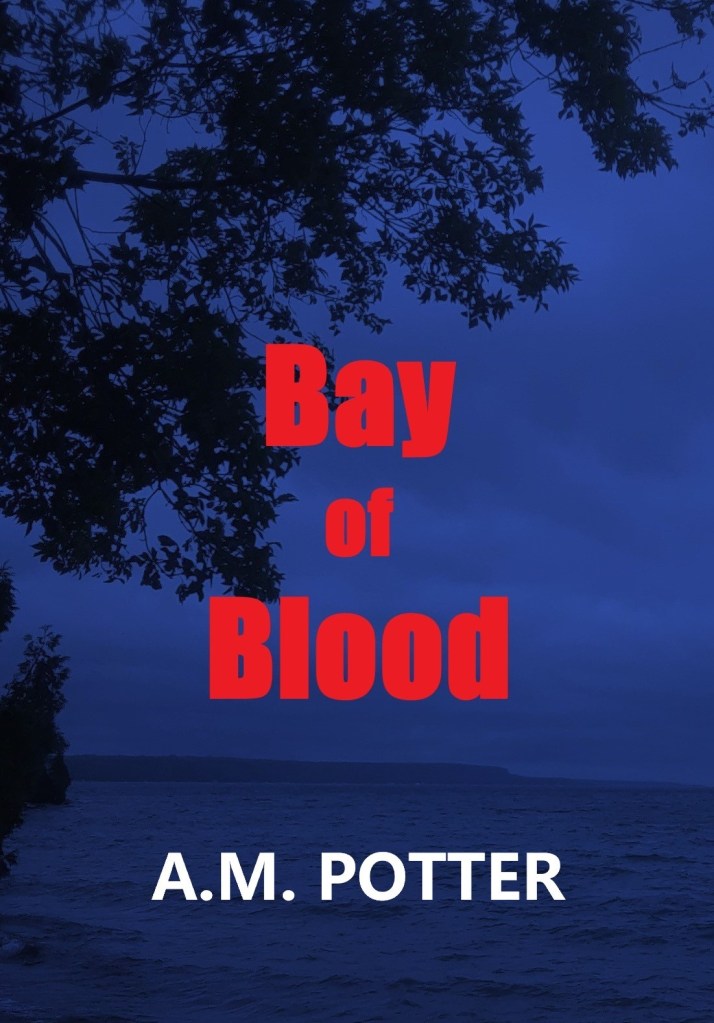
Kudos for Bay of Blood: “A vivid page-turner” ~ Steven Heighton, Governor General’s Award Winner | “Quintessential Canadian mystery” ~ Lesley Choyce, Dartmouth Book Award Winner
Tom Thomson is a Canadian myth, a national icon. The famous painter died mysteriously in Canoe Lake, Algonquin Park, Ontario on July 8, 1917. The famous Canadian painter in Bay of Blood dies on July 8, 2017. Like Thomson, he often paints from out on the water, in his case from a sailboat, not a canoe. He’s part of an artist’s collective called the Gang of Eight, not the Group of Seven. His small skiff is named ‘West Wind,’ after Thomson’s most famous painting. So, there are references to Tom Thomson, but the famous painter in Bay of Blood is not Thomson.
Given Thomson’s iconic status, I didn’t want to meddle with his memory. Also, and this was very important to me, I didn’t want to offend his family in any way. I want him to rest in peace at Leith United Cemetery, or perhaps Canoe Lake. To this date, there’s no consensus as to where he’s buried.
Incidentally, when Thomson painted from his canoe, he used an easel-like device attached near the bow that held an 8×10-inch wood panel. He’d paint the panels very quickly, with minimal brushstrokes. It was his way of capturing scenes that would later be turned into full-size canvases in his winter studio. In essence, it was like today’s painter photographing a scene prior to painting it.
Leaving all that aside, I borrowed from the Tom Thomson myth. I didn’t fictionalize the man. I fictionalized the myth. I took elements from the myth and reshaped them. For example, Thomson is considered the Father of Canadian Painting. The famous painter in Bay of Blood leads a 21st century art movement that presents Canada to the world.
However, for the most part, I created new elements. I wrote a murder mystery about a painter called Thom Tyler, a TT Number 2, who, admittedly, is a Thomson Redux. But he’s soon dead.
Bay of Blood is narrated by an OPP (Ontario Provincial Police) detective based in the Bruce Peninsula. Detective Sergeant Eva Naslund is half Swedish and half Scottish-Canadian. Her father is from Sweden; her mother, from the Bruce.
Eva Naslund operates in a largely male domain, the jurisdiction of homicide. She goes to work with a homicide team who arrive in the Bruce from OPP Central in Orillia. They find no useful blood or DNA evidence, and no prints – no footprints, bootprints, or fingerprints. Nothing.
They turn to financial forensics. Tyler’s paintings are worth millions, yet he’s deeply in debt to banks and his art agent. As with many artists, he doesn’t get much when his work is sold. His agent gets the lion’s share.
Here’s a peep into the novel from Doctor Sherrill Grace, a UBC Professor and a Thomson scholar: “There are many clever details in Potter’s version of events with close parallels to Tom Thomson’s life and death. However, Potter takes his readers on a fascinating 21st-century chase, with bells and whistles never dreamt of one hundred years ago: cell phones, female detectives, Russian operatives, and shady Toronto art dealers. Whether or not you follow the Thomson saga, you’ll relish Bay of Blood’s new take on events.”
Thank you, Doctor Grace.
For Eva Naslund, working in the male homicide domain is tricky. The old-boy network throws a few spanners her way. But she rolls with the punches, giving back as good as she gets. She’s quick on her feet, she’s feisty. However, bottom line, she toes the line. For the good of the investigation and the good of her community – the Bruce Peninsula – she’s a team player. That’s not a spoiler alert. But this may be. Thom Tyler is not the only dead body in the novel.
Okay. No More. You know the saying. If I tell you any more, I’ll have to kill you. Well, in a book.
I’ve included a short excerpt from Bay of Blood, from an article about Tyler’s death:
Mr. Tyler, one of Canada’s most celebrated painters, was especially fond of nature. He traversed the Great Lakes for months at a time in a sailboat outfitted with an artist’s studio, in search of what he called the lost soul of Canada ….


 North Noir