Crime Time: A Two-headed Compulsion

Why do writers write crime novels? Why do readers read them? We’d have to delve into the DSM (Diagnostic and Statistical Manual of Mental Disorders). 😉 We’d need a thousand hours – no, a million.

Let’s look at things from the reader’s side of the page. That’s what really matters: why readers read, not why writers write. It’s a large question. However, I’m going to take a succinct approach. Crime fiction suffuses the zeitgeist. Crime readers have favourite styles: cozy mystery, private investigator, police procedural, etc. Regardless, they’re all fascinated with one thing. Murder. Why?

I see it as a two-headed compulsion. One, readers want to experience the other side of life: death. Two, they want to experience fear. They crave it, but only fictionally: fear of the unknown, fear of the invader, fear of reprisal, fear of something that will disrupt their life – or end it. Fictionally, of course.

PS: Book sellers claim that everything hinges on sales, i.e., on book buyers. I beg to differ. Buyers are great, but everything hinges on readers. Period. That includes those who borrow from libraries or share a book a dozen times. The more shares (the more readers), the merrier.

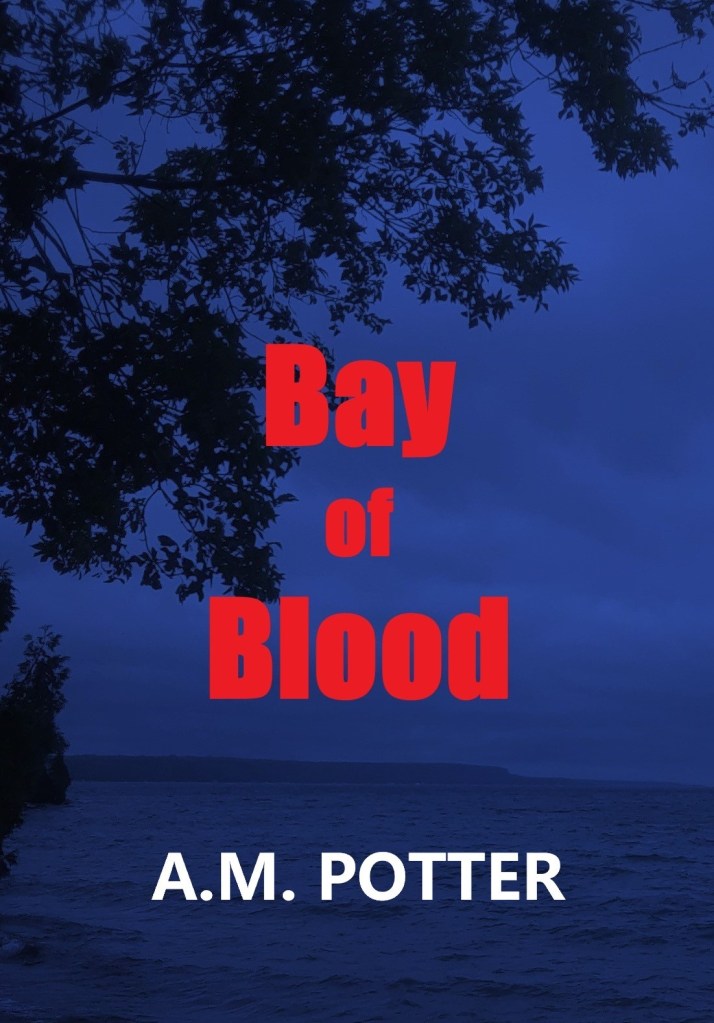
Bay of Blood: Tom Thomson Redux

Kudos for Bay of Blood: “A vivid page-turner” ~ Steven Heighton, Governor General’s Award Winner | “Quintessential Canadian mystery” ~ Lesley Choyce, Dartmouth Book Award Winner

Tom Thomson is a Canadian myth, a national icon. The famous painter died mysteriously in Canoe Lake, Algonquin Park, Ontario on July 8, 1917. The famous Canadian painter in Bay of Blood dies on July 8, 2017. Like Thomson, he often paints from out on the water, in his case from a sailboat, not a canoe. He’s part of an artist’s collective called the Gang of Eight, not the Group of Seven. His small skiff is named ‘West Wind,’ after Thomson’s most famous painting. So, there are references to Tom Thomson, but the famous painter in Bay of Blood is not Thomson.

Given Thomson’s iconic status, I didn’t want to meddle with his memory. Also, and this was very important to me, I didn’t want to offend his family in any way. I want him to rest in peace at Leith United Cemetery, or perhaps Canoe Lake. To this date, there’s no consensus as to where he’s buried.

Incidentally, when Thomson painted from his canoe, he used an easel-like device attached near the bow that held an 8×10-inch wood panel. He’d paint the panels very quickly, with minimal brushstrokes. It was his way of capturing scenes that would later be turned into full-size canvases in his winter studio. In essence, it was like today’s painter photographing a scene prior to painting it.

Leaving all that aside, I borrowed from the Tom Thomson myth. I didn’t fictionalize the man. I fictionalized the myth. I took elements from the myth and reshaped them. For example, Thomson is considered the Father of Canadian Painting. The famous painter in Bay of Blood leads a 21st century art movement that presents Canada to the world.

However, for the most part, I created new elements. I wrote a murder mystery about a painter called Thom Tyler, a TT Number 2, who, admittedly, is a Thomson Redux. But he’s soon dead.

Bay of Blood is narrated by an OPP (Ontario Provincial Police) detective based in the Bruce Peninsula. Detective Sergeant Eva Naslund is half Swedish and half Scottish-Canadian. Her father is from Sweden; her mother, from the Bruce.

Eva Naslund operates in a largely male domain, the jurisdiction of homicide. She goes to work with a homicide team who arrive in the Bruce from OPP Central in Orillia. They find no useful blood or DNA evidence, and no prints – no footprints, bootprints, or fingerprints. Nothing.

They turn to financial forensics. Tyler’s paintings are worth millions, yet he’s deeply in debt to banks and his art agent. As with many artists, he doesn’t get much when his work is sold. His agent gets the lion’s share.

Here’s a peep into the novel from Doctor Sherrill Grace, a UBC Professor and a Thomson scholar: “There are many clever details in Potter’s version of events with close parallels to Tom Thomson’s life and death. However, Potter takes his readers on a fascinating 21st-century chase, with bells and whistles never dreamt of one hundred years ago: cell phones, female detectives, Russian operatives, and shady Toronto art dealers. Whether or not you follow the Thomson saga, you’ll relish Bay of Blood’s new take on events.”

Thank you, Doctor Grace.

For Eva Naslund, working in the male homicide domain is tricky. The old-boy network throws a few spanners her way. But she rolls with the punches, giving back as good as she gets. She’s quick on her feet, she’s feisty. However, bottom line, she toes the line. For the good of the investigation and the good of her community – the Bruce Peninsula – she’s a team player. That’s not a spoiler alert. But this may be. Thom Tyler is not the only dead body in the novel.

Okay. No More. You know the saying. If I tell you any more, I’ll have to kill you. Well, in a book.

I’ve included a short excerpt from Bay of Blood, from an article about Tyler’s death:

Mr. Tyler, one of Canada’s most celebrated painters, was especially fond of nature. He traversed the Great Lakes for months at a time in a sailboat outfitted with an artist’s studio, in search of what he called the lost soul of Canada ….

Bay of Blood selected for submission to the ITW 2020 Thriller Award Contest

Bay of Blood was selected by Black Opal Books for submission to the 2020 ITW (International Thriller Writers) Thriller Award Contest [Best Paperback Original Novel Category]

A Siege of Bitterns – A Birder Murder mystery

A Siege of Bitterns by Steve Burrows. Dundurn Press. 2014.

Reviewed by A.M. Potter. ® 2019.

A Siege of Bitterns is the first novel in the “Birder Murder” series. The book won the 2015 Arthur Ellis Award for Best First Novel (for non-Canucks, the Arthur Ellis is the Canadian Nobel Prize of crime writing). A Siege of Bitterns is worthy of the prize.

The novel’s protagonist, DI Domenic Jejeune, is a Canadian transplanted to the UK. The mystery unfolds in the small Norfolk town of Saltmarsh, premier birding country. One might say Dejeune is a reluctant detective. He likes bird watching as much, if not more, than solving murders. To some of his fellow police officers, he’s a strange bird indeed. He occasionally comes across as a tortured eccentric. One wonders how he can solve crimes. But he does. His odd individualism is reminiscent of some of the most famous detectives in fiction. Shades of Sherlock Holmes, anyone? Or Hercule Poirot?

I won’t review the plot itself. I rarely do. I prefer to let the reader discover it. On the other hand, I will say that it’s clever, with a tangled bird’s nest of false starts and red herrings. You’ll exercise your grey cells on this one. Burrows delivers big personalities whose individuality springs from their dialog and thoughts, not from what they wear or drive. He also delivers enticing chapter endings, leaving the reader with a hook. What’s going to happen next? I want to know.

Burrows writes with flair. He deploys plenty of descriptive prose, yet he doesn’t lose momentum. I feel I’m in good hands. After a little flair, he returns to the core of crime writing: logistics. Clues and red herrings.

https://en.wikipedia.org/wiki/Steve_Burrows

The opening lines of A Siege of Bitterns:

“At its widest point, the marsh stretched almost a quarter of a mile across the north Norfolk coastline. Here, the river that had flowed like a silver ribbon through the rolling farmlands to the west finally came to rest, spilling its contents across the flat terrain, smoothing out the uneven contours, seeping silently into every corner ….”

My Favourite British Novel

My favourite British novel? That’s a tough one. Of course, I’ve made it easier on myself by saying “British,” thus bypassing the Irish and James Joyce’s Ulysses.

Many literary historians consider Joseph Andrews (1742) by Henry Fielding the first British novel. However, there is vociferous debate. Le Morte d’Arthur (1485) by Thomas Malory sometimes gets the nod. But that doesn’t matter to me. This isn’t a dissertation. It’s my personal choice.

My favourite British novel is …. London Fields by Martin Amis, published in 1989.

Say what?!” I know, many people might not have London Fields on their radar, let alone as their favourite. They favour Nobel-prize winners like William Golding (Lord of the Flies) or Kazuo Ishiguro (The Remains of the Day). They extoll novels by Charles Dickens, Jane Austen, Virginia Woolf, George Orwell, Ian McEwan, Julian Barnes, or Zadie Smith. That’s quite a list, but give me Martin Amis and London Fields. {I’m not claiming it’s the best. It’s simply my favourite.}

Give me the sheer exuberance of Amis’ prose. Will he go off on tangents about pubs, sex, or the sky over London? You bet he will. If it’s not your cup of British novel, you’ll know within pages. Me, I knew within a page that I’d keep reading.

Some find London Fields an acquired taste. It’s not politically-correct. It’s misogynistic. Others compare London Fields to Joyce’s Ulysses. It’s inventive and discursive. Like Ulysses, it’s been called crass and pornographic. Regardless of labels, London Fields gets under your skin. It’s part noir, part berk realism, part literary fiction. Like a certain beer brewed in Nova Scotia (an IPA), those who like it like it a lot. I’m one of them.

Amis delivers an extended amusement park ride, a rollercoaster of pathos and poignancy. The capers are simultaneously low-brow and high-brow. Think Monty Python on the page. {Not a Python fan? Give London Fields a pass.}

When I want twists, over-the-top characters, and zaniness, I re-read London Fields. I don’t only read it for the singularly inventive prose (no one writes like Martin Amis), but also for the plot itself. It’s a black comic murder mystery, a Brit noir par excellence. Right up my alley.

From the opening of London Fields: “This is the story of a murder. It hasn’t happened yet. But it will. (It had better.) I know the murderer, I know the murderee. I know the time, I know the place. I know the motive (her motive) and I know the means. I know who will be the foil, the fool, the poor foal, also utterly destroyed. And I couldn’t stop them, I don’t think, even if I wanted to.”

NB: This passage was written in 1989: “America was going insane. In her own way. And why not? Countries go insane like people go insane …. All over the world countries reclined on couches or sat in darkened rooms chewing dihydrocodeine and Temazepam or lay in boiling baths or twisted in straightjackets or stood banging their heads against padded walls. Some had been insane all their lives, and some had gone insane and then got better again and then gone insane again …. America had had her neuroses before, like when she tried giving up drink, like when she started finding enemies within, like when she thought she could rule the world …. In a way she was never like everywhere else. Most places just are something, but America had to mean something too, hence her vulnerability – to make-believe, to false memory, false destiny.”

The heroine, the murderee, on the death of love: [The earth] seemed to have eternal youth but now she’s ageing fast, like an addict …. We used to live and die without any sense of the planet getting older, of mother earth getting older, living and dying. We used to live outside history. But now we’re all coterminous. We’re inside history now, on its leading edge, with the wind ripping past our ears. Hard to love, when you’re bracing yourself for impact.

https://en.wikipedia.org/wiki/London_Fields_(novel)