The King of California Noir

Who’s the King of California Noir? Michael Connelly. Some might say Raymond Chandler (his protagonist was Philip Marlowe) or Dashiell Hammett (Sam Spade). Others make a case for Alfred Hitchcock. You don’t have to be a writer to be the King. However, in my eyes, Connelly is the reigning King of California Noir. His output surpasses that of Chandler or Hammett, but that’s not all. Harry (short for Hieronymus) Bosch, Connelly’s protagonist, is a more realistic and enduring lead than either Marlowe or Spade.

This post circles Connelly’s Bosch series (it doesn’t review a particular novel). The Detective Harry Bosch novels are set in Los Angeles. Bosch is an LAPD detective. He’s a Vietnam vet, a former “tunnel rat” who operated in the vast underground mazes used by the Vietcong. He has no pretensions, and no patience for those who do. He’s tough and diligent, but he’s not a wooden macho man, not overly taciturn or snarky. Unlike Sam Spade, for example, Bosch is not hard-boiled to the core, which makes him an easier man to know. Hammett shows very little of Spade’s emotions and only the manly side. After all, Spade was a hard-edged dick. I’m not denigrating Hammett’s fictional MO. He wrote in the 1920s and 30s; hard-boiled was the schtick.

Connelly’s Bosch novels deliver plenty of explanatory details, making it easy to follow the story. Admittedly, that can slow the pace. He’s partial to what I call Hollywood plotting, such as extended car chases, but, hey, the books are set in LA. He’s more mainstream than Ian Rankin, for example. In some places, Connelly’s info-dumps are too long. Ditto for his police procedural details. At times, the prose is workman-like, which is not surprising given his prodigious output, almost a book a year. I’m OK with all of that. I get sharply plotted whodunits. I get a tough yet sympatico protagonist. I get LA.

A few quotes from the Bosch opus ….

“Bosch knew every trick there was when it came to planting obfuscation and misdirection in a murder book. He could write a how-to manual on the art of turning the [pre-trial] discovery into a nightmare for a defense lawyer. It had been his routine practice back in the day to redact words in reports without rhyme or reason, to intermittently remove the toner cartridge from the squad room photocopier so that pages and pages he was turning over were printed so lightly they were impossible or at least headache-inducing to read.”

“Bosch never got used to viewing crime scenes. He had been to hundreds of them and seen the result of human inhumanity too many times to count. He always thought that if he got used to it, then he had lost something inside that was needed to do the job right. You had to have an emotional response. It was that response that lit the match that started the fire.”
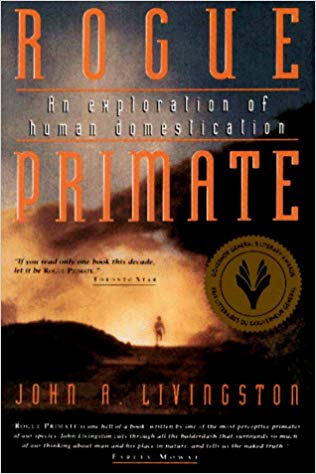
The Rogue Primate – Us

Rogue Primate: An Exploration of Human Domestication by John A. Livingston. Key Porter Books. 1995.

Introductory Note: I wrote the following book review in 1995. Why am I republishing it (with a few edits)? What does it have to do with crime fiction? You’ll see below. Or not. If you’re not into book reviews, feel free to skip to the bottom of the post. {Review first published by A.M. Potter. ® 1995.}

John A. Livingston is a well-known naturalist and professor at York University (Toronto). Rogue Primate opens with a bang: “What humans have visited upon this planet may legitimately be seen as an ecospheric holocaust.”

Livingston’s views on the damage perpetrated by human beings — rogue primates, as he calls us — are as extreme as those of the staunchest Green activist. Yet Rogue Primate isn’t an eco rant. Livingstone doesn’t point fingers and assign blame. Rather, he blames us all. He attempts to explain why we as a species have become a planet-wide scourge. His thesis is based on the premise that we’ve sold out, jettisoned our inherent wildness. We’ve allowed ourselves to become so specialized and technologically advanced that we’re no longer true primates. Instead, we’re virtually machines, voracious automatons plundering the planet.

Livingston’s views place him far to the left of sustainable development economists. In his eyes, sustainable development is “a full-blown oxymoron.” Yet he is also right-wing in his radicalism. He disagrees with scientists who see the scope of modern medicine as harmfully over-reaching. Rogue Primate‘s thesis is not new. We homogenize and pauperize nature because we lack both intrinsic inhibitions (altruistic love of other life forms) and extrinsic controls (predators). Livingston claims that domestication is humanity’s main enemy. He challenges us to change not only our day-to-day consumption habits, but also our fundamental belief systems, to replace the anthropocentric credo of humanism with a spiritual belief that Nature is more important than Man.

Many readers will agree with Livingston’s lofty ideals, yet most of us will do little more than pay lip service to them. Eco-prophets like Livingston seem to be asking the impossible. Pull our plugs, abandon our cars, eat insects? We realize that our actions pose a threat to the survival of certain species, and possibly the planet itself, yet we continue consuming and discarding. Will we learn to place the interests of Nature above those of Man. Will we contain ourselves? Or will some Rough Beast, as yet unborn, usurp the Rogue Primate?

Postscript: 2019

Some might say that not much has changed in almost twenty-five years. I certainly do. We Homo sapiens are altering our planet. I accept that fact. I don’t think that life on earth will be terrible, but it will be different. Very different. However, that’s my opinion. And it’s not why I posted this review.

Let’s get to writing. This isn’t an eco blog. While I’m waiting for Godot, or for some Rough Beast to slouch toward Washington and/or Beijing, I read and write crime fiction. I’m not saving the planet, I know. However, I don’t let rogue primates off the hook. There’s more than one kind. To wit, there are murderers, including those who inhabit the pages of North Noir, starting with Bay of Blood and The Color Red.

Post-Postscript:

John A. Livingston died in 2006. See: https://en.wikipedia.org/wiki/John_Livingston_(naturalist). In addition to his writing, he was widely known as the voice-over for Canada’s 1960s Hinterland Who’s Who series.