
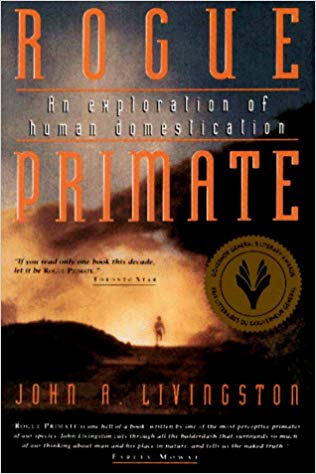
Rogue Primate: An Exploration of Human Domestication by John A. Livingston. Key Porter Books. 1995.
Introductory Note: I wrote the following book review in 1995. Why am I republishing it (with a few edits)? What does it have to do with crime fiction? You’ll see below. Or not. If you’re not into book reviews, feel free to skip to the bottom of the post. {Review first published by A.M. Potter. ® 1995.}
John A. Livingston is a well-known naturalist and professor at York University (Toronto). Rogue Primate opens with a bang: “What humans have visited upon this planet may legitimately be seen as an ecospheric holocaust.”
Livingston’s views on the damage perpetrated by human beings — rogue primates, as he calls us — are as extreme as those of the staunchest Green activist. Yet Rogue Primate isn’t an eco rant. Livingstone doesn’t point fingers and assign blame. Rather, he blames us all. He attempts to explain why we as a species have become a planet-wide scourge. His thesis is based on the premise that we’ve sold out, jettisoned our inherent wildness. We’ve allowed ourselves to become so specialized and technologically advanced that we’re no longer true primates. Instead, we’re virtually machines, voracious automatons plundering the planet.
Livingston’s views place him far to the left of sustainable development economists. In his eyes, sustainable development is “a full-blown oxymoron.” Yet he is also right-wing in his radicalism. He disagrees with scientists who see the scope of modern medicine as harmfully over-reaching. Rogue Primate‘s thesis is not new. We homogenize and pauperize nature because we lack both intrinsic inhibitions (altruistic love of other life forms) and extrinsic controls (predators). Livingston claims that domestication is humanity’s main enemy. He challenges us to change not only our day-to-day consumption habits, but also our fundamental belief systems, to replace the anthropocentric credo of humanism with a spiritual belief that Nature is more important than Man.
Many readers will agree with Livingston’s lofty ideals, yet most of us will do little more than pay lip service to them. Eco-prophets like Livingston seem to be asking the impossible. Pull our plugs, abandon our cars, eat insects? We realize that our actions pose a threat to the survival of certain species, and possibly the planet itself, yet we continue consuming and discarding. Will we learn to place the interests of Nature above those of Man. Will we contain ourselves? Or will some Rough Beast, as yet unborn, usurp the Rogue Primate?
Postscript: 2019
Some might say that not much has changed in almost twenty-five years. I certainly do. We Homo sapiens are altering our planet. I accept that fact. I don’t think that life on earth will be terrible, but it will be different. Very different. However, that’s my opinion. And it’s not why I posted this review.
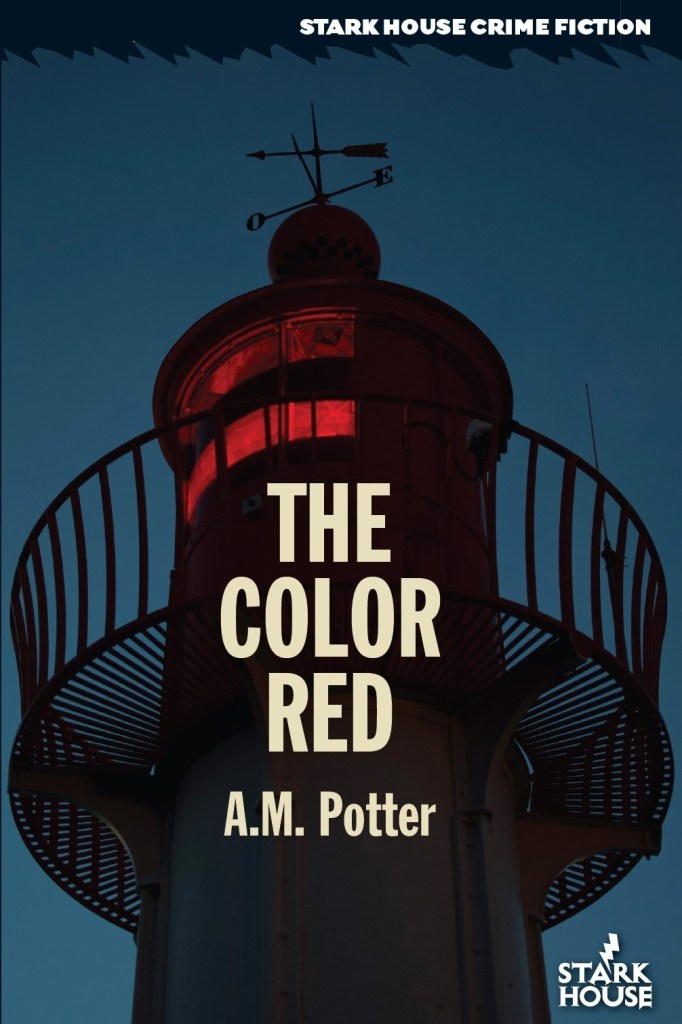
Let’s get to writing. This isn’t an eco blog. While I’m waiting for Godot, or for some Rough Beast to slouch toward Washington and/or Beijing, I read and write crime fiction. I’m not saving the planet, I know. However, I don’t let rogue primates off the hook. There’s more than one kind. To wit, there are murderers, including those who inhabit the pages of North Noir, starting with Bay of Blood and The Color Red.
Post-Postscript:
John A. Livingston died in 2006. See: https://en.wikipedia.org/wiki/John_Livingston_(naturalist). In addition to his writing, he was widely known as the voice-over for Canada’s 1960s Hinterland Who’s Who series.
 North Noir