A Discovery of Strangers by Rudy Wiebe. Knopf Canada. 1994
Introductory Note: I wrote the following book review in 1995. Why am I republishing it (with a few edits)? What does it have to do with writing fiction? Two words: Voice Appropriation. If you want to bypass the review, feel free to skip to the bottom of the post. {Review first published by A.M. Potter. ® 1995}
Rudy Wiebe won the 1973 Governor-General’s Award for Fiction (Canada) for The Temptations of Big Bear. Long before the advent of movies like Dances with Wolves, Wiebe’s indigenous characters took centre stage. He appropriated a multitude of historical voices, regardless of ethnicity or station in life, and allowed each to tell their own version of events.
Wiebe’s second G-G award-winning novel, A Discovery of Strangers, follows the same general format. The reader views the 1820-21 Franklin Expedition through the eyes of not only the English explorers, but also the Canadian voyagers and Yellowknife natives who made it possible. Much of the story is told from the point-of-view of a young indigenous woman called Greenstockings. Wiebe could be accused of double voice appropriation. He’s a white male who wrote as a female, not to mention an indigenous female.
A Discovery of Strangers is as much a love story as a retelling of history. The beautiful Greenstockings is a man-magnet. One of Franklin’s junior officers, Robert Hood, is besotted with her. Wiebe’s account of their deepening attraction – which finally erupts inside her father’s lodge – is as tender and tragic as a troubadour tale.
A reader cannot help noting the stylistic affinities of Wiebe’s two award-winning novels. Both use similar narrative devices – flashbacks, visionary dreams, multiple points-of-view – as well as similar prose styles. It’s almost as if the author said to himself, Hmm, that worked before. I’ll do it again.
Wiebe’s descriptive passages perfectly capture the sub-Arctic terrain, largely harsh and unforgiving in the eyes of the whites, no less harsh in the eyes of the Yellowknife, yet also pregnant with life and joy. We read of eerie ice caves, the fickle migrations of the caribou, and the endless threat of starvation. We enter the past. It may be long-lost but, in Wiebe’s hands, it is also eternally-present.
Postscript, 2019:
When A Discovery of Strangers was published (1994), some people weren’t happy with Wiebe’s double voice appropriation, that is, writing from the point-of-view (POV) of both an indigenous person and a female. It’s no easy task for a male to write convincingly as a female, let alone for a white male to write as an indigenous female. However, Wiebe succeeded. Stylistically.
As to being politically correct, in 2019 many more people challenge Wiebe’s voice appropriation than twenty-five years ago. For the most part today, voice appropriation is frowned upon. A white male like me shouldn’t write from the POV of an indigenous person. I also shouldn’t write from the POV of a female. But I do. The protagonist and sole narrator of my first North Noir detective series is a female, Eva Naslund, a Swedish-Scottish Canadian.
Why do I use a female narrator? The answer is not simple. I understand that, for some people, it’s not politically correct. I understand that I can’t think or feel exactly like a female. {Incidentally, it seems to be OK for females to use male POVs. For example, in the mystery genre, Louise Penny’s protagonist is Armand Gamache, and then there’s Agatha Christie’s Hercule Poirot.} Despite the recent voice appropriation furor, I persist. While I’m a supposedly honorable person (according to friends, and I don’t even pay them), I’m not always politically correct. I don’t think anyone is. I also persist because I write fiction. Works of imagination. Say no more.
My final spiel: I don’t care what narrative voice(s) you use. Write as a Purple Martian who’s in love with non-gender-specific star dust. If your POV is convincing, I’ll read it.
Who’s the King of California Noir? Michael Connelly. Some might say Raymond Chandler (his protagonist was Philip Marlowe) or Dashiell Hammett (Sam Spade). Others make a case for Alfred Hitchcock. You don’t have to be a writer to be the King. However, in my eyes, Connelly is the reigning King of California Noir. His output surpasses that of Chandler or Hammett, but that’s not all. Harry (short for Hieronymus) Bosch, Connelly’s protagonist, is a more realistic and enduring lead than either Marlowe or Spade.
This post circles Connelly’s Bosch series (it doesn’t review a particular novel). The Detective Harry Bosch novels are set in Los Angeles. Bosch is an LAPD detective. He’s a Vietnam vet, a former “tunnel rat” who operated in the vast underground mazes used by the Vietcong. He has no pretensions, and no patience for those who do. He’s tough and diligent, but he’s not a wooden macho man, not overly taciturn or snarky. Unlike Sam Spade, for example, Bosch is not hard-boiled to the core, which makes him an easier man to know. Hammett shows very little of Spade’s emotions and only the manly side. After all, Spade was a hard-edged dick. I’m not denigrating Hammett’s fictional MO. He wrote in the 1920s and 30s; hard-boiled was the schtick.
Connelly’s Bosch novels deliver plenty of explanatory details, making it easy to follow the story. Admittedly, that can slow the pace. He’s partial to what I call Hollywood plotting, such as extended car chases, but, hey, the books are set in LA. He’s more mainstream than Ian Rankin, for example. In some places, Connelly’s info-dumps are too long. Ditto for his police procedural details. At times, the prose is workman-like, which is not surprising given his prodigious output, almost a book a year. I’m OK with all of that. I get sharply plotted whodunits. I get a tough yet sympatico protagonist. I get LA.
A few quotes from the Bosch opus ….
“Bosch knew every trick there was when it came to planting obfuscation and misdirection in a murder book. He could write a how-to manual on the art of turning the [pre-trial] discovery into a nightmare for a defense lawyer. It had been his routine practice back in the day to redact words in reports without rhyme or reason, to intermittently remove the toner cartridge from the squad room photocopier so that pages and pages he was turning over were printed so lightly they were impossible or at least headache-inducing to read.”
“Bosch never got used to viewing crime scenes. He had been to hundreds of them and seen the result of human inhumanity too many times to count. He always thought that if he got used to it, then he had lost something inside that was needed to do the job right. You had to have an emotional response. It was that response that lit the match that started the fire.”
Why do so many people read crime/mystery fiction? Why do so many watch crime/mystery creations? Think contemporary cozies, historical ones, true crime, CSI spinoffs, law and order procedurals, etc. Why the interest?
The number of crime/mystery novels published annually is right up there with romance novels. Crime/mystery stories are central to our current cultural milieu. People must get something out of the genre. Of course, there’s the voyeur element. “Look, he’s bloodier than buffalo guts.” “Hey, her head’s half there. That incision looks like shark teeth.”
I know what I like writing about crime fiction: the push to tell a tale, to put plot first and prose style second. See my blog on deserting James Joyce and going to the dark side.
I’m not a psychologist. However, I’m going to take a stab at answering why people find murder mysteries so fascinating. Violent unexpected death is horrendous. People cannot or do not want to face it directly. One way of handling murder, one way of coming to terms with the worst of all human crimes, is to watch someone solve it. “Look, they caught the bastard.”
Perhaps crime fiction is soothing. It conquers evil, and somehow puts the world in a positive light. Good guys win, bad guys go to jail. On the flip side, I could be barking up the wrong tree. Maybe people just want blood and guts.
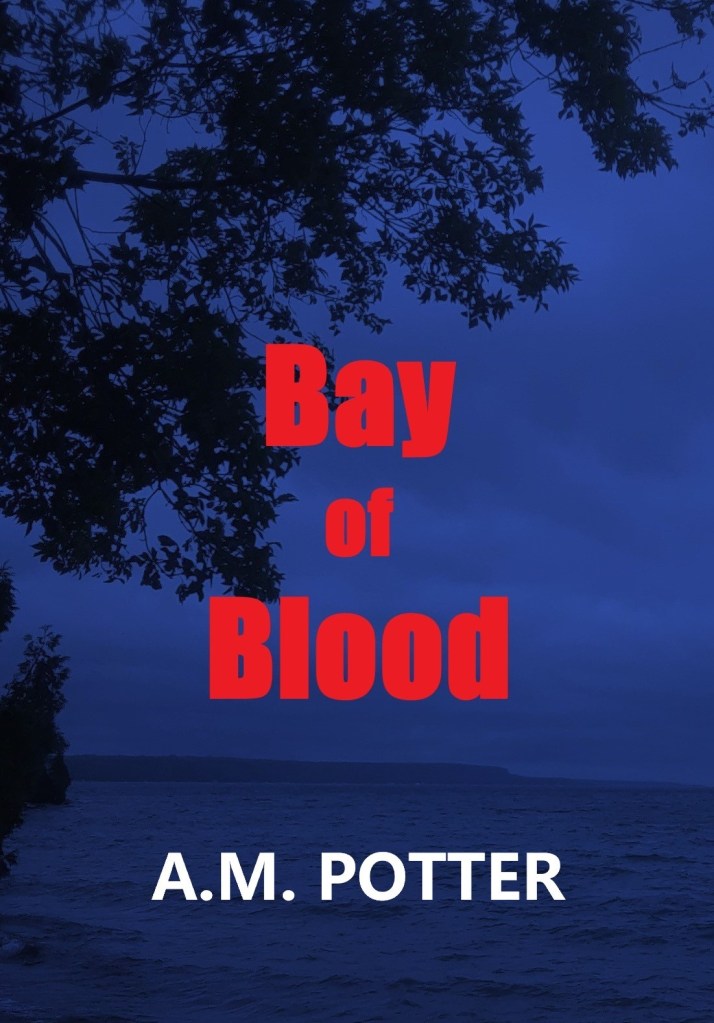
Bay of Blood, the first novel in the North Noir Canada Series, featuring Detective Eva Naslund. Release date: March 23, 2019. Published by Black Opal Books. Click here for sales.
Bay of Blood. World-renowned painter Thom Tyler is murdered in Georgian Bay, Canada. The consensus is that Tyler had no enemies. Why would anyone murder him?
Detective Eva Naslund goes to work with a homicide team from OPP Central. They find no useful blood, print, or DNA evidence. They turn to financial forensics and criminal psychology. Tyler’s paintings are worth millions, yet he’s deeply in debt to banks and his art agent. Just as the investigation opens a new lead, courtesy of Tyler’s friend, J.J. MacKenzie, MacKenzie is murdered. The team is back to ground zero — with two murders to solve ….
Bay of Blood – Opening Chapters
Chapter 1
Colpoys Bay, Georgian
Bay, Ontario, July 8th:
Predawn stars salted the sky. Thom Tyler pushed his skiff off the dock, paddled hard to point her nose into the wind, and immediately raised the sail. Off he tore, skimming across the water toward White Cloud Island.
To
the east, the sky shed its blackness. A pale red flush crept across the bay. He
settled in the cockpit. A few moments later, his neck-hairs bristled. He
sensed hostile eyes burning into his head. Shifting nonchalantly, he leaned
portside to inspect the shore. All quiet. Just the inky outline of Mallory
Beach. Still, he was sure someone was there.
A car engine started. Very strange, he thought. There were never any cars about at this hour. He
saw no lights. The slowly revving engine headed north. Was
someone tracking him?
Forget it, he told himself and faced forward.
He turned his mind to sailing, easing out the mainsheet
to spill some speed. Still, he flew over the water. He could smell the north: the clean sharpness of
boreal forests. However, in the back of his mind, he felt uneasy. He sensed
something out there waiting for him. His neck twitched. The strange car fueled
his anxiety. Something was waiting for him.
Chapter 2
Wiarton, Bruce Peninsula. Ontario Provincial Police
(OPP) Station, July 8th:
“Got a little run for you, Naslund.”
Detective Eva Naslund looked up to see the detachment chief standing at
her desk. Ted Bickell’s pants were perfectly pressed. The creases looked like
they could slice someone’s throat. “A boat just washed up near Cape Commodore,”
Bickell said. “Caller reported blood. Lots of it.” He paused. “But I’m sure you
can handle it.”
Naslund nodded. Fair point. She’d had nothing
but B&Es for the past two months.
Bickell handed her a slip of paper. Donnie Rathbone. HW 1, 100220.
“Not an emergency,” he said. “No speeding.”
She shrugged. On a day like today, she’d drive
anywhere in the Bruce, fast or slow, the farther from Staff Sergeant Bickell,
the better. As she drove east, the morning sun tinted Colpoy’s Bay a deep golden
red. The limestone cliffs above Mallory Beach not only reflected the sun, they
shimmered like suns themselves. A convoy of high white clouds raced across the
sky.
Fifteen minutes later, she pulled off Highway
One at a weathered blue bungalow with an unobstructed view of Georgian Bay. A
run-down barn flanked the house. Across the highway, parched-looking Christmas
trees stretched inland as far as she could see. It’d been a hot, dry summer. As
she stepped out of her unmarked car, the wind whipped her pants around her
legs. Georgian Bay was running high, churned by a powerful northwesterly. The
Georgian was usually restless. It was essentially an inland sea. On calm days there
was often a sea roll, even if only long and slow. Today there was a wave train.
Line after line of breakers roared ashore.
She knocked on the front door. The man who answered
was tall and fit, bearded, about fifty years old.
“Donnie Rathbone?” she asked.
The man nodded.
“Detective Sergeant Naslund, OPP.”
“Detective Sergeant, eh? Sent out a top dog,
did they?”
She chuckled and covertly pressed the
recording button on her duty phone. “No, sir. They had no choice. I’m the only
detective in Wiarton.”
“Come on in then. Place is a bit of a mess.
Wife’s away.”
“When the cat’s away,” Naslund said.
Rathbone grinned and led her to the kitchen.
Passing the stove, she noticed a pan of congealed bacon. It was almost full. He
pointed out the window. “There it is.”
She followed his finger and saw a boat
seemingly hauled up on the shore. “When did you spot her?”
“About seven. I got up a bit late, at six,
went right to the barn, fed my pigs, and came back for breakfast. I noticed it
then. So I walked down.” Rathbone paused. “That’s when I saw the blood. A
helluva lot of blood. I came right back and called nine-one-one.”
“Did you touch the boat?”
“No.”
“Did you touch anything aboard it?”
“No. I watch them CSI programs, you know.”
“All right. So, you noticed the boat about
seven?”
“Right. Like I said, I was running late. Got
up and went straight to my pigs.”
Rathbone sounded a bit nervous. In any case,
the boat could have been there well before 0700 hours. “Did you happen to look
out to your shore last night?”
“Nothing there last night, not when I went to
bed. At ten-thirty that was.”
“Did you see or hear anyone on your property
this morning?”
“No.”
“Notice anyone in the bay? Boats? Swimmers?”
“Didn’t see any.”
“Did you see anything strange on the highway?”
“No.”
“No one walking or running? No unusual
vehicles?”
“No.”
“Thank you.”
***
Given the apparently large amount of blood,
Naslund drew a hooded clean-suit from her trunk and stepped into it. Instantly
she felt constricted, yet twice as big. She pulled on shoe covers and gloves
and walked carefully down the path to the shore, examining the ground. One set
of boot prints going, one coming back. Rathbone, if the man was telling the
truth. She’d impound his boots on the way out.
As she reached the fine-graveled shore, she
eyed the boat. A skiff, about six meters long. The bow faced southeast. The
stern was still in the water, but the boat wasn’t moving. She’d settled into
the gravel, as if she’d been there for days. Naslund figured the wind had
driven her hard into shore. The mast and boom were intact, the sail torn to
shreds. The hull was wooden, dove-gray with white trim.
That dove-gray hull. It looked like her friend
Thom Tyler’s skiff. She stepped to the side and read the boat’s name: West Wind. Christ, it was Thom’s skiff. Had he been forced to
abandon ship?
Digging inside her clean-suit, she fished out
her duty phone and called Thom’s cottage. His other half answered. “Morning,
Carrie. Eva here. Is Thom there?”
“No. He’s out fishing.”
“When did he leave?”
“About five.”
Naslund glanced at the time — 0738. “Did he go out alone?”
“As far as I know. I was in bed when he left.
Anything wrong?”
Naslund ducked the question. “Are you sure he
went out this morning?”
“Yes.”
“Okay. Call me when he gets home.” Naslund
gave Carrie her OPP cell number, telling herself Thom would show. He’d
abandoned ship and swam to shore, or a passing boat took him aboard.
Knowing that Thom always wore a blue lifevest,
Naslund pulled a pair of binoculars from her CS kitbag. Focusing the
binoculars, she turned her head slowly, scanning the bay in sweeps.
No sign of a blue lifevest, no floating
bodies.
Follow the wind, she told herself. The
northwesterly will drive anyone southeast. She stepped to the edge of the bay
and scanned again and again.
Nothing.
Let it ride, she thought. Thom would show. He
was the strongest swimmer she knew.
She walked up to the skiff and immediately saw
a lot of blood, most of it inside the hull. She knew there’d been even more.
The wave train would have washed some away. She paced the starboard side. At
midship, two large splatter patterns spread from the gunwale down to the bilge,
both about half-a-meter in width and a meter in length. She leaned closer. The
main pattern presented wide-angle spray
consistent with blows from a blunt force weapon. A lead pipe, she thought,
maybe a crowbar. The other pattern resembled the spurting caused by a stab
wound. Near them were two lines of fat
circular drops, indicating blood falling at a fast rate, exiting large wounds.
From the vector of the lines, she knew the source fell forward, toward the
gunwale. Or was pushed.
She started down the port side. Halfway along it, she found the centerboard keel sticking out from the hull, almost completely detached, like a broken limb. No surprise. The skiff had grounded. She kept walking, finding no blood on the port side and none on the mast, sail, or mainsheet. However, there was blood on the starboard side of the boom. Had it hit Thom and knocked him overboard? Maybe. She re-evaluated the scene. No sharp protrusions on the boom. Two splatter patterns. If the boom had hit Thom, there would likely only be one — consistent with blunt force blood, not spurting blood. She filed the thought away.
Returning to the stains, she bent down on one knee. Her clean-suit felt even more constricting. She sniffed. The stains didn’t smell fishy or gamey. She looked for scales or animal hair. Nothing. She stood and surveyed the blood again. It couldn’t be from a small animal, like a dog or cat — there was too much of it. Could be from a deer, she reasoned, or a cow. Or a pig. Rathbone? Could be. But there were no other signs of animals present. The blood was likely human.
Seeing no signs of activity near the skiff — no prints or scuffs, no evidence of a struggle — she assumed the shore wasn’t a crime scene. But the blood splatter suggested the skiff was. She had a blood kit in her car, but decided to call the white coats. Pulling out her duty phone, she called Central.
“Serology. Gerard LaFlamme.”
Hot
Doc, she thought, not that LaFlamme appreciated the
nickname. He’d filed a complaint against two female detectives. They’d admitted
wrongdoing then relabeled him THD, Très Hot Doc. “Morning, LaFlamme. Detective
Naslund, Bruce Peninsula.”
“Naslund, what gives?”
“Got some blood on a wooden boat. Suspicion of
assault. I’d run it myself but I need a foolproof ID.”
“Okay. Where are you?”
She gave him the location and hung up.
Starting at the bow, she paced twenty steps inland, away from the skiff. Head
down, eyes focused on the ground, she searched a grid about 200 meters square.
No boot or foot indentations in the loose gravel, no prints on harder ground,
no wheel or tire tracks leading away from the skiff. No butts, bottles, or cans.
No wrappers. Nothing.
She walked back to the skiff and deliberately
paced the starboard side from the waterline to the bow, this time with a
magnifying glass. No hairs or fibers. Four partial fingerprints, wet and faint.
Difficult to lift. Best left to a white coat. She paced down the port side to
the waterline, but found nothing. Yet she sensed something was wrong.
She stood still and surveyed the whole boat,
her eyes finally returning to the bow. That was it. No anchor rode-line tied to
the bow. And no anchor. Why would Thom go out without an anchor? He’d just
added a new rode-line. She’d watched
him do it at the marina three mornings ago…
***
“Good afternoon,” Naslund had said, as she always did first thing in the
morning. She gauged a person’s mood by how they responded.
“Good evening,” Thom replied.
Naslund grinned. As usual, Thom liked to be kidded. He wore old shorts and a sleeveless T-shirt. His tanned arms had the appearance of weathered leather. With his outdoorsman’s face and long black hair, he looked like a Great Lakes voyageur. He moored his bigger sailboat at the marina, but was working on the skiff from his cottage boathouse.
She surveyed the skiff, a Mackinaw whose boom was raised so that a
six-footer could easily slide under it.
“Want a muffin?” he asked and pointed to a paper bag. “Go on, have one. You
need to eat more.”
She did, but didn’t want to show it. Since
she’d split up with her husband Pete, she wasn’t eating much. Although life had
returned to normal, her appetite hadn’t.
“You’re always on the go,” Thom said.
“Me?” she deadpanned.
“Yep, you.” He chuckled. “Curiosity killed the
cop.”
“But luck brought her back.” She reached for a
muffin. As she ate it, Thom tied a new anchor rode to the bow with a solid knot, a
tight bowline.
***
Now, eying the scene, Naslund took two steps
back and dropped to her haunches. The clean-suit protested, slowing her
movement. From hip-level, she studied the skiff. Something about it told her
that Thom was dead. In her sixteen years on the force, she’d seen plenty of
dead bodies. They’d all seemed vacant, abandoned by life. The skiff looked like
them. Abandoned forever.
Naslund grimaced. Hoping for the best, she
called in a Search & Rescue and then notified Bickell by radiophone. Although she normally used her duty cell,
old-boy Bickell preferred radio-comm. He’d order his daily fish &
chips by radio if he could. Afterward, she stood and faced the bay,
trying to muster her optimism. Maybe they’d find Thom alive. Maybe he’d show
up.
Turning her back to the wind, she called
Carrie, who answered immediately.
“Eva here. I found Thom’s boat, but not him. I
called the Coast Guard for a search.”
“What? A search? Why?”
“No need to worry. Thom probably swam into
shore. He’ll show up soon.” Naslund stopped. She didn’t feel like lying.
Besides, Carrie had one of the sharpest minds she knew.
“Then why search for him?”
She had no good answer. She held back the information
about the blood. “His skiff came ashore near Cape Commodore. Now we need to
find him.”
“Find him then. Find him!”
“We will.”
“I want to help. Where are you?”
“You can’t come here.” Naslund knew the Coast
Guard would call in the OPP Marine Unit from Wiarton. “Phone the station,” she
told her. “They’ll be organizing search teams.”
“Okay.” Carrie hung up.
Naslund sighed. As much
as she wanted to, she couldn’t join the search. She had an
investigation to run. Worse still, she felt sure Thom was dead. Her friend
wouldn’t simply walk out of the bay, laughing off the northwesterly.
She inhaled deeply, held her breath for three seconds, exhaled slowly, and repeated the cycle five times — a trick she’d learned from Pete, a sports-therapist. It stilled her mind.
She eyed the skiff again. If the blood was human, they’d need a full forensic team. In the meantime, she needed one constable to secure the site and another to canvass the neighborhood to the east. After they arrived she’d revisit Rathbone then take the west. She glanced up at Rathbone’s kitchen window. The man was watching her. She called the station. The dispatcher answered.
Naslund identified herself and gave the
address. “Got a CS. Send two PCs.”
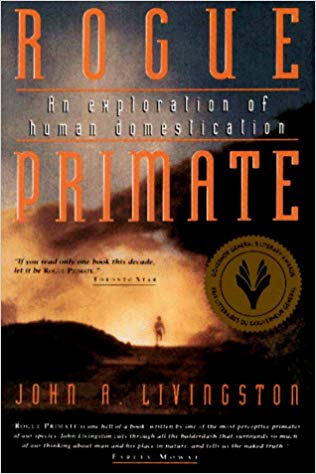
Rogue Primate: An Exploration of Human Domesticationby John A. Livingston. Key Porter Books. 1995.
Introductory Note: I wrote the following book review in 1995. Why am I republishing it (with a few edits)? What does it have to do with crime fiction? You’ll see below. Or not. If you’re not into book reviews, feel free to skip to the bottom of the post. {Review first published by A.M. Potter. ® 1995.}
John A. Livingston is a well-known naturalist and professor at York University (Toronto). Rogue Primate opens with a bang: “What humans have visited upon this planet may legitimately be seen as an ecospheric holocaust.”
Livingston’s views on the damage perpetrated by human beings — rogue primates, as he calls us — are as extreme as those of the staunchest Green activist. Yet Rogue Primate isn’t an eco rant. Livingstone doesn’t point fingers and assign blame. Rather, he blames us all. He attempts to explain why we as a species have become a planet-wide scourge. His thesis is based on the premise that we’ve sold out, jettisoned our inherent wildness. We’ve allowed ourselves to become so specialized and technologically advanced that we’re no longer true primates. Instead, we’re virtually machines, voracious automatons plundering the planet.
Livingston’s views place him far to the left of sustainable development economists. In his eyes, sustainable development is “a full-blown oxymoron.” Yet he is also right-wing in his radicalism. He disagrees with scientists who see the scope of modern medicine as harmfully over-reaching. Rogue Primate‘s thesis is not new. We homogenize and pauperize nature because we lack both intrinsic inhibitions (altruistic love of other life forms) and extrinsic controls (predators). Livingston claims that domestication is humanity’s main enemy. He challenges us to change not only our day-to-day consumption habits, but also our fundamental belief systems, to replace the anthropocentric credo of humanism with a spiritual belief that Nature is more important than Man.
Many readers will agree with Livingston’s lofty ideals, yet most of us will do little more than pay lip service to them. Eco-prophets like Livingston seem to be asking the impossible. Pull our plugs, abandon our cars, eat insects? We realize that our actions pose a threat to the survival of certain species, and possibly the planet itself, yet we continue consuming and discarding. Will we learn to place the interests of Nature above those of Man. Will we contain ourselves? Or will some Rough Beast, as yet unborn, usurp the Rogue Primate?
Postscript: 2019
Some might say that not much has changed in almost twenty-five years. I certainly do. We Homo sapiens are altering our planet. I accept that fact. I don’t think that life on earth will be terrible, but it will be different. Very different. However, that’s my opinion. And it’s not why I posted this review.
Let’s get to writing. This isn’t an eco blog. While I’m waiting for Godot, or for some Rough Beast to slouch toward Washington and/or Beijing, I read and write crime fiction. I’m not saving the planet, I know. However, I don’t let rogue primates off the hook. There’s more than one kind. To wit, there are murderers, including those who inhabit the pages of North Noir, starting with Bay of Blood and The Color Red.