Voice Appropriation – Then and Now

A Discovery of Strangers by Rudy Wiebe. Knopf Canada. 1994

Introductory Note: I wrote the following book review in 1995. Why am I republishing it (with a few edits)? What does it have to do with writing fiction? Two words: Voice Appropriation. If you want to bypass the review, feel free to skip to the bottom of the post. {Review first published by A.M. Potter. ® 1995}

Rudy Wiebe won the 1973 Governor-General’s Award for Fiction (Canada) for The Temptations of Big Bear. Long before the advent of movies like Dances with Wolves, Wiebe’s indigenous characters took centre stage. He appropriated a multitude of historical voices, regardless of ethnicity or station in life, and allowed each to tell their own version of events.

Wiebe’s second G-G award-winning novel, A Discovery of Strangers, follows the same general format. The reader views the 1820-21 Franklin Expedition through the eyes of not only the English explorers, but also the Canadian voyagers and Yellowknife natives who made it possible. Much of the story is told from the point-of-view of a young indigenous woman called Greenstockings. Wiebe could be accused of double voice appropriation. He’s a white male who wrote as a female, not to mention an indigenous female.

A Discovery of Strangers is as much a love story as a retelling of history. The beautiful Greenstockings is a man-magnet. One of Franklin’s junior officers, Robert Hood, is besotted with her. Wiebe’s account of their deepening attraction – which finally erupts inside her father’s lodge – is as tender and tragic as a troubadour tale.

A reader cannot help noting the stylistic affinities of Wiebe’s two award-winning novels. Both use similar narrative devices – flashbacks, visionary dreams, multiple points-of-view – as well as similar prose styles. It’s almost as if the author said to himself, Hmm, that worked before. I’ll do it again.

Wiebe’s descriptive passages perfectly capture the sub-Arctic terrain, largely harsh and unforgiving in the eyes of the whites, no less harsh in the eyes of the Yellowknife, yet also pregnant with life and joy. We read of eerie ice caves, the fickle migrations of the caribou, and the endless threat of starvation. We enter the past. It may be long-lost but, in Wiebe’s hands, it is also eternally-present.

Postscript, 2019

When A Discovery of Strangers was published (1994), some people weren’t happy with Wiebe’s double voice appropriation, that is, writing from the point-of-view (POV) of both an indigenous person and a female. It’s no easy task for a male to write convincingly as a female, let alone for a white male to write as an indigenous female. However, Wiebe succeeded. Stylistically.

As to being politically correct, in 2019 many more people challenge Wiebe’s voice appropriation than twenty-five years ago. For the most part today, voice appropriation is frowned upon. A white male like me shouldn’t write from the POV of an indigenous person. I also shouldn’t write from the POV of a female. But I do. The protagonist and sole narrator of my first North Noir detective series is a female, Eva Naslund, a Swedish-Scottish Canadian.

Why do I use a female narrator? The answer is not simple. I understand that, for some people, it’s not politically correct. I understand that I can’t think or feel exactly like a female. {Incidentally, it seems to be OK for females to use male POVs. For example, in the mystery genre, Louise Penny’s protagonist is Armand Gamache, and then there’s Agatha Christie’s Hercule Poirot.} Despite the recent voice appropriation furor, I persist. While I’m a supposedly honorable person (according to friends, and I don’t even pay them), I’m not always politically correct. I don’t think anyone is. I also persist because I write fiction. Works of imagination. Say no more.

My final spiel: I don’t care what narrative voice(s) you use. Write as a Purple Martian who’s in love with non-gender-specific star dust. If your POV is convincing, I’ll read it.

Post-Postscript:

See Rudy Wiebe on Wikipedia: https://en.wikipedia.org/wiki/Rudy_Wiebe.
Cisco – Flannery O’Connor meets Elmore Leonard in San Fran

Cisco by Jim White. Dark Passages Publishing. 2019.

Reviewed by A.M. Potter. ® 2019.

Cisco tells the tale of a cunning man, a kidnapper with a Biblical sense of wrath. The novella unfolds on the streets of San Fran. Its plotline is reminiscent of a Flannery O’Connor story. The reader gets religiosity and hard-scrabble life in equal measure. In addition to the O’Connor fictional MO, we are in Elmore Leonard land. White delivers Cisco with sharp, clear prose. There are no wasted words. We are immediately pulled into the story.

The protagonist, Cisco, knows his Bible, but he doesn’t turn his cheek. He’s a lawless evangelical. He has no apparent remorse. A speech impediment humanizes him. However, it turns out to be fake. Some think he’s a mad man. Is he ‘criminally insane’? I’d say not. He knows exactly what he’s doing. He’s a killer/kidnapper of Biblical, as in monstrous, proportions, both physically and mentally. His strength appears to come from God, and yet he is a Fallen Man (echoing Prospero and Caliban in ‘The Tempest’).

On the other side of the thin blue line, the antagonist, Detective Helen McCurda, is a seasoned cop with no quit. She’s tough, competent, and sympatico. She’s everything you want a cop to be. However, Cisco is the engine of the story. His actions and complex personality move the plot forward. As in Leonard’s novels, the criminals in Cisco are far more interesting than the cops. I like that. The cops can’t always be the stars. But I do have a minor complaint – which is really a compliment. I want more of Cisco. The story ended too soon.

The King of California Noir

Who’s the King of California Noir? Michael Connelly. Some might say Raymond Chandler (his protagonist was Philip Marlowe) or Dashiell Hammett (Sam Spade). Others make a case for Alfred Hitchcock. You don’t have to be a writer to be the King. However, in my eyes, Connelly is the reigning King of California Noir. His output surpasses that of Chandler or Hammett, but that’s not all. Harry (short for Hieronymus) Bosch, Connelly’s protagonist, is a more realistic and enduring lead than either Marlowe or Spade.

This post circles Connelly’s Bosch series (it doesn’t review a particular novel). The Detective Harry Bosch novels are set in Los Angeles. Bosch is an LAPD detective. He’s a Vietnam vet, a former “tunnel rat” who operated in the vast underground mazes used by the Vietcong. He has no pretensions, and no patience for those who do. He’s tough and diligent, but he’s not a wooden macho man, not overly taciturn or snarky. Unlike Sam Spade, for example, Bosch is not hard-boiled to the core, which makes him an easier man to know. Hammett shows very little of Spade’s emotions and only the manly side. After all, Spade was a hard-edged dick. I’m not denigrating Hammett’s fictional MO. He wrote in the 1920s and 30s; hard-boiled was the schtick.

Connelly’s Bosch novels deliver plenty of explanatory details, making it easy to follow the story. Admittedly, that can slow the pace. He’s partial to what I call Hollywood plotting, such as extended car chases, but, hey, the books are set in LA. He’s more mainstream than Ian Rankin, for example. In some places, Connelly’s info-dumps are too long. Ditto for his police procedural details. At times, the prose is workman-like, which is not surprising given his prodigious output, almost a book a year. I’m OK with all of that. I get sharply plotted whodunits. I get a tough yet sympatico protagonist. I get LA.

A few quotes from the Bosch opus ….

“Bosch knew every trick there was when it came to planting obfuscation and misdirection in a murder book. He could write a how-to manual on the art of turning the [pre-trial] discovery into a nightmare for a defense lawyer. It had been his routine practice back in the day to redact words in reports without rhyme or reason, to intermittently remove the toner cartridge from the squad room photocopier so that pages and pages he was turning over were printed so lightly they were impossible or at least headache-inducing to read.”

“Bosch never got used to viewing crime scenes. He had been to hundreds of them and seen the result of human inhumanity too many times to count. He always thought that if he got used to it, then he had lost something inside that was needed to do the job right. You had to have an emotional response. It was that response that lit the match that started the fire.”

Book Review Omnibus: Sister-in-Law, The Chase, Fields of Lies

Sister-in-Law by M. R. Morgan. Black Opal Books. 2018.

Reviewed by A.M. Potter. ® 2019.

You don’t have to follow US politics or love political/psychological thrillers to be captured by this novel. It draws you in — even if you’re oblivious to Washington DC. If you’ve shut out the US Feds, disregard your past proclivities and dive into Sister-in-Law. Although I grew up in the US and Canada, I now live in Canada. However, place of residence doesn’t matter. Sister-in-Law is accessible to anyone and everyone.

Morgan’s plotline is clever without being unnecessarily circuitous. His prose is clear and precise. His characters’ motivations are easy to comprehend. However, he doesn’t spoon-feed you. He delivers exactly what you need. You fill in the rest.

I’m not going to expand on the plotline (a troubled seductress becomes the president’s sister-in-law to get to the president himself; echoes of Marilyn Monroe, anyone), other than to say that the sister-in-law gets to her target. And that’s not a spoiler alert. It’s what happens along the way that counts. Enjoy the twists. Get your politics with a bang (double-entendre intended). Given the current political climate in Washington (shutdowns, disarray, doublespeak), you might be wishing the president actually had a sister-in-law.

The Chase by Leonardus Rougoor. Black Opal Books. 2017.

Reviewed by A.M. Potter. ® 2019.

Leonardus Rougoor’s The Chase transports you to a place most people don’t go. You enter the mind of a vigilante. Joseph is a solo vigilante, a man who has taken the law unto himself. We only get his first name, which seems appropriate. It makes him more unknowable.

In his quest for justice, Joseph is judge, jury, and executioner. He’s not entirely at ease with his calling. As he relates, “if polite society and the police [in the USA] can’t or won’t do anything … then I guess the problem falls on me. God, I wish it wasn’t like this.” Yet Joseph doesn’t shirk his self-appointed duty. He kills those he finds guilty. In his mind, “a bad upbringing doesn’t give you the right to lead a bad life.” Furthermore, if “you live by the sword it is only fitting that you die by the sword …. This, of course, doesn’t apply to me. I’m on a mission.”

Joseph wields god-like power. In his mind, he has to. American Society has given him no choice. He avenges pimps, drug dealers, neo-Nazis, the Klan, and porn producers, among others. Yet his main target is personal – it’s the killer of his wife and unborn child, Dennis Jackson. Jackson is still a killer. He’s a wary prey, and his tracking takes patience and skill. Fortunately, Joseph possesses both in abundance.

The Chase bares the soul of America. Joseph rationalizes his killings, and yet he wonders if he’s any better than the scum he kills. As a reader, you inhabit his mind, you share his triumphs and doubts. Will you agree with him? Will you understand him? Jump in and find out.

Author’s website: leonardusrougoor.com

Fields of Lies by Sabina Gabrielle Carrara. 2019.

Reviewed by A.M. Potter. ® 2019.

What’s better in a murder mystery than a web of lies? A field of lies. How do you up the ante on that? Add more than one field. In Sabina Gabrielle Carrara’s Fields of Lies, multiple fields of friendship and marriage have been enjoying apparent peace for over twenty years. Yet the hand of death is simply slumbering.

As Fields of Lies opens in the quaint Irish village of Seacross, life seems benign. However, Bernadette and Michael Greaney are living a lie. They don’t love each other. The seemingly solid walls of their marriage are in fact unsteady facades. And then the facades are ripped open. A prodigal son returns to the village. The rift in the Greaney marriage widens. Gabrielle Carrara delivers all the elements of a cracking whodunit: seething discontent, extramarital affairs, deceit, payback, jealousy.

A man who was responsible for a crime two decades ago – and who escaped punishment – is murdered. We have motive: payback. But where’s the opportunity? It is cleverly hidden. A parade of lies unfolds before the perpetrator is apprehended. A high tide of red herrings expertly deflects the reader from the whodunit. Will the killer come to light? Will the denizens of Seacross stare down death and despair? Read Fields of Lies to unearth the answers. See how deceit awakens the hand of death.

The Rogue Primate – Us

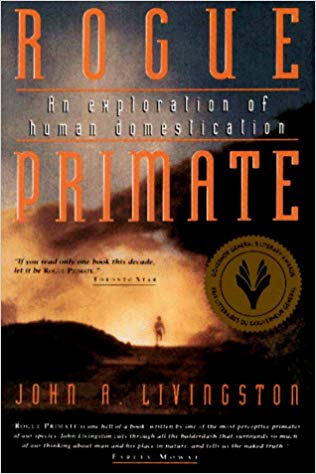
Rogue Primate: An Exploration of Human Domestication by John A. Livingston. Key Porter Books. 1995.

Introductory Note: I wrote the following book review in 1995. Why am I republishing it (with a few edits)? What does it have to do with crime fiction? You’ll see below. Or not. If you’re not into book reviews, feel free to skip to the bottom of the post. {Review first published by A.M. Potter. ® 1995.}

John A. Livingston is a well-known naturalist and professor at York University (Toronto). Rogue Primate opens with a bang: “What humans have visited upon this planet may legitimately be seen as an ecospheric holocaust.”

Livingston’s views on the damage perpetrated by human beings — rogue primates, as he calls us — are as extreme as those of the staunchest Green activist. Yet Rogue Primate isn’t an eco rant. Livingstone doesn’t point fingers and assign blame. Rather, he blames us all. He attempts to explain why we as a species have become a planet-wide scourge. His thesis is based on the premise that we’ve sold out, jettisoned our inherent wildness. We’ve allowed ourselves to become so specialized and technologically advanced that we’re no longer true primates. Instead, we’re virtually machines, voracious automatons plundering the planet.

Livingston’s views place him far to the left of sustainable development economists. In his eyes, sustainable development is “a full-blown oxymoron.” Yet he is also right-wing in his radicalism. He disagrees with scientists who see the scope of modern medicine as harmfully over-reaching. Rogue Primate‘s thesis is not new. We homogenize and pauperize nature because we lack both intrinsic inhibitions (altruistic love of other life forms) and extrinsic controls (predators). Livingston claims that domestication is humanity’s main enemy. He challenges us to change not only our day-to-day consumption habits, but also our fundamental belief systems, to replace the anthropocentric credo of humanism with a spiritual belief that Nature is more important than Man.

Many readers will agree with Livingston’s lofty ideals, yet most of us will do little more than pay lip service to them. Eco-prophets like Livingston seem to be asking the impossible. Pull our plugs, abandon our cars, eat insects? We realize that our actions pose a threat to the survival of certain species, and possibly the planet itself, yet we continue consuming and discarding. Will we learn to place the interests of Nature above those of Man. Will we contain ourselves? Or will some Rough Beast, as yet unborn, usurp the Rogue Primate?

Postscript: 2019

Some might say that not much has changed in almost twenty-five years. I certainly do. We Homo sapiens are altering our planet. I accept that fact. I don’t think that life on earth will be terrible, but it will be different. Very different. However, that’s my opinion. And it’s not why I posted this review.

Let’s get to writing. This isn’t an eco blog. While I’m waiting for Godot, or for some Rough Beast to slouch toward Washington and/or Beijing, I read and write crime fiction. I’m not saving the planet, I know. However, I don’t let rogue primates off the hook. There’s more than one kind. To wit, there are murderers, including those who inhabit the pages of North Noir, starting with Bay of Blood and The Color Red.

Post-Postscript:

John A. Livingston died in 2006. See: https://en.wikipedia.org/wiki/John_Livingston_(naturalist). In addition to his writing, he was widely known as the voice-over for Canada’s 1960s Hinterland Who’s Who series.